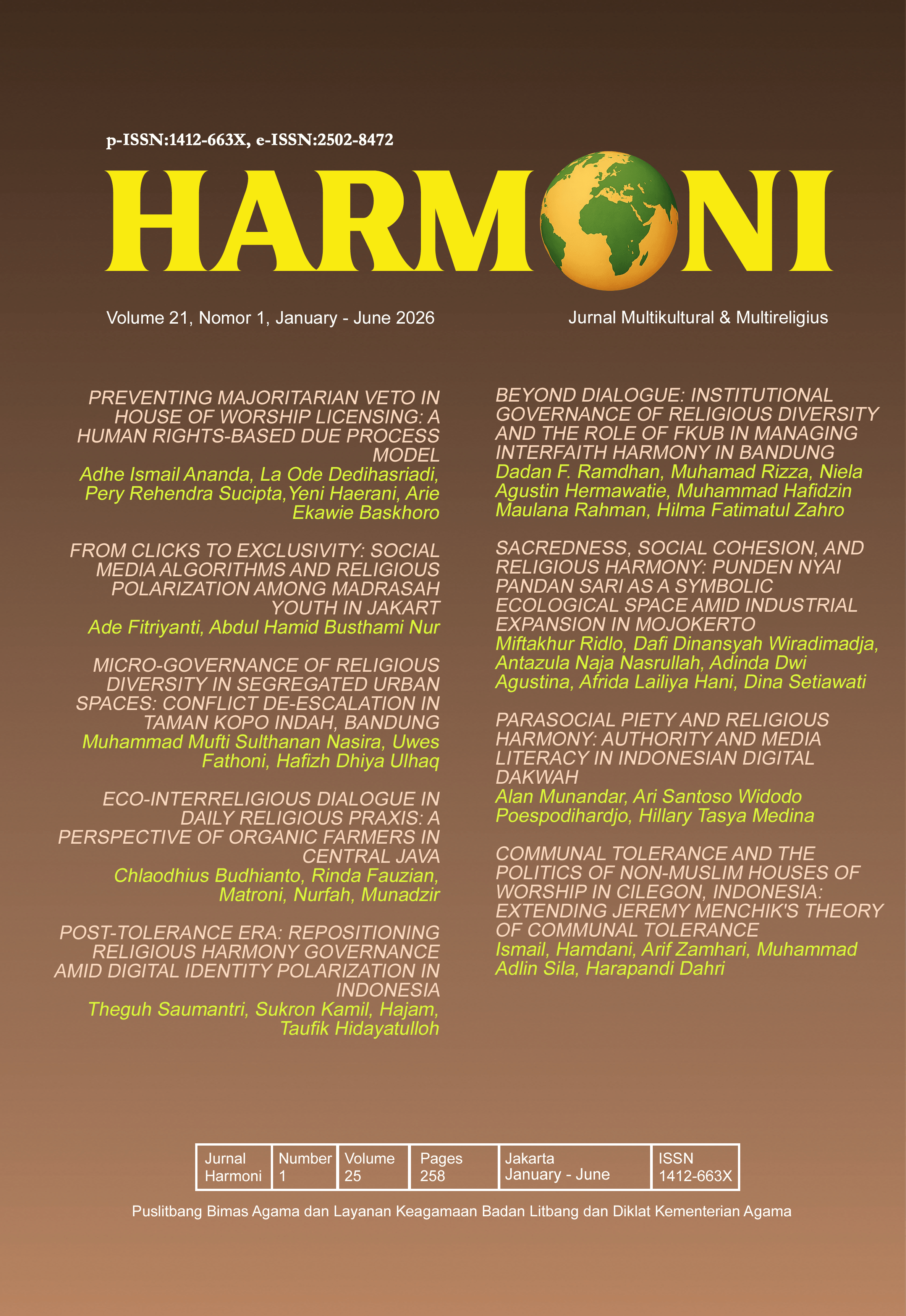
FROM CLICKS TO EXCLUSIVITY: SOCIAL MEDIA ALGORITHMS AND RELIGIOUS POLARIZATION AMONG MADRASAH YOUTH IN JAKARTA
DOI:
https://doi.org/10.32488/harmoni.v25i1.954Keywords:
Agama dan Media; Agama Online; Otoritas; Otoritas Keagamaan, social polarization, Remaja, echo chambers, Filter bubble, Moderasi beragama, Algoritmic literacy, Interfaith harmony, Digital religionAbstract
The growth of algorithm-driven social media has reshaped how Muslim youth in Indonesia access religious knowledge and form religious attitudes, raising concerns for religious moderation and social harmony in a plural society. This study examines the influence of social media algorithmic exposure on religious polarization among madrasah students and explores how this dynamic relates to authority, openness, and interfaith implications. Employing a mixed-methods sequential explanatory design, the quantitative phase surveyed 300 students from eight madrasahs (Madrasah Aliyah and Tsanawiyah) in East and North Jakarta selected through proportionate stratified random sampling, using a validated five-point Likert questionnaire (Cronbach's alpha = 0.86). The qualitative phase comprised in-depth interviews with twelve students and three Islamic Education teachers, which were analysed thematically and integrated with the survey results through a joint display. Simple linear regression showed a significant positive effect of algorithmic exposure on religious polarization (β = 0.559; R² = 0.312; p < 0.001). Students with higher exposure exhibited more exclusive attitudes and lower openness to differing views, while recommendation systems on YouTube and TikTok reinforced echo chambers and shifted religious authority from teachers toward digital figures. The study proposes the concept of “algorithmic religiosity” to describe a religious orientation shaped by the selection and amplification logic of platforms. Because the design is correlational and exposure was self-reported, the findings imply, rather than directly demonstrate, risks to interfaith openness; a concrete implication is embedding algorithmic literacy and religious moderation content within madrasah curricula, delivered in formats able to compete with the engagement logic of social media platforms.
Abstrak
Perkembangan media sosial berbasis algoritma telah mengubah cara remaja Muslim Indonesia mengakses pengetahuan agama dan membentuk sikap keberagamaan, sehingga menimbulkan tantangan bagi moderasi beragama dan keharmonisan sosial dalam masyarakat yang plural. Penelitian ini menganalisis pengaruh paparan algoritma media sosial terhadap polarisasi keagamaan di kalangan siswa madrasah serta mengkaji keterkaitannya dengan otoritas, keterbukaan, dan implikasi antaragama. Dengan desain mixed-methods sequential explanatory, tahap kuantitatif mensurvei 300 siswa dari delapan madrasah (Aliyah dan Tsanawiyah) di Jakarta Timur dan Jakarta Utara yang dipilih melalui proportionate stratified random sampling, menggunakan kuesioner skala Likert lima tingkat yang telah divalidasi (Cronbach's alpha = 0,86). Tahap kualitatif berupa wawancara mendalam terhadap dua belas siswa dan tiga guru Pendidikan Agama Islam, dianalisis secara tematik dan diintegrasikan dengan hasil survei melalui joint display. Regresi linier sederhana menunjukkan pengaruh positif yang signifikan dari paparan algoritma terhadap polarisasi keagamaan (β = 0,559; R² = 0,312; p < 0,001). Siswa dengan paparan tinggi menunjukkan sikap yang lebih eksklusif dan keterbukaan yang lebih rendah, sementara sistem rekomendasi YouTube dan TikTok memperkuat ruang gema dan menggeser otoritas keagamaan dari guru ke figur digital. Penelitian ini mengajukan konsep “keberagamaan algoritmik” untuk menjelaskan orientasi religius yang dibentuk oleh logika seleksi dan amplifikasi pada platform. Karena desain penelitian bersifat korelasional dan paparan diukur melalui laporan diri, temuan ini mengimplikasikan, bukan membuktikan secara langsung, adanya risiko terhadap keterbukaan antaragama; implikasi konkretnya adalah perlunya mengintegrasikan literasi algoritmik dan konten moderasi beragama ke dalam kurikulum madrasah dengan format yang mampu bersaing dengan logika keterlibatan pada platform media sosial.
Downloads
References
Akmaliah, W. (2020). The demise of moderate Islam: New media, contestation, and reclaiming religious authorities. Indonesian Journal of Islam and Muslim Societies, 10(1), 1–24. https://doi.org/10.18326/ijims.v10i1.1-24
Andok, M. (2024). The impact of online media on religious authority. Religions, 15(9), 1103. https://doi.org/10.3390/rel15091103
Bail, C. A., Argyle, L. P., Brown, T. W., Bumpus, J. P., Chen, H., Hunzaker, M. B. F., Lee, J., Mann, M., Merhout, F., & Volfovsky, A. (2018). Exposure to opposing views on social media can increase political polarization. Proceedings of the National Academy of Sciences, 115(37), 9216–9221. https://doi.org/10.1073/pnas.1804840115
Bakshy, E., Messing, S., & Adamic, L. A. (2015). Exposure to ideologically diverse news and opinion on Facebook. Science, 348(6239), 1130–1132. https://doi.org/10.1126/science.aaa1160
Barberá, P., Jost, J. T., Nagler, J., Tucker, J. A., & Bonneau, R. (2015). Tweeting from left to right. Psychological Science, 26(10), 1531–1542. https://doi.org/10.1177/0956797615594620
Bozdag, C. (2020). Managing diverse online networks in the context of polarization: Understanding how we grow apart on and through social media. Social Media + Society, 6(4). https://doi.org/10.1177/2056305120975713
Campbell, H. A. (2013). Digital religion: Understanding religious practice in new media worlds. Routledge.
Campbell, H. A., & Evolvi, G. (2020). Contextualizing current digital religion research on emerging technologies. Human Behavior and Emerging Technologies, 2(1), 5–17. https://doi.org/10.1002/hbe2.149
Chan, J., To, H.-P., & Chan, E. (2006). Reconsidering social cohesion: Developing a definition and analytical framework for empirical research. Social Indicators Research, 75(2), 273–302. https://doi.org/10.1007/s11205-005-2118-1
Cinelli, M., De Francisci Morales, G., Galeazzi, A., Quattrociocchi, W., & Starnini, M. (2021). The echo chamber effect on social media. Proceedings of the National Academy of Sciences, 118(9). https://doi.org/10.1073/pnas.2023301118
Fakhruroji, M. (2025). Socially Distanced, Digitally Engaged: Mediatization of Religious Practices of Indonesian Digital Natives during covid-19 Pandemic. Journal of Religion, Media and Digital Culture, 14(1), 23–44. https://doi.org/10.1163/21659214-bja10125
Febrian, H. (2024). Visualizing authority: Rise of the religious influencers on Instagram. Social Media + Society, 10(4). https://doi.org/10.1177/20563051241286850
Floridi, L. (2019). The logic of information: A theory of philosophy as conceptual design. Oxford University Press.
Geschke, D., Lorenz, J., & Holtz, P. (2019). The triple‐filter bubble: Using agent‐based modelling to test a meta‐theoretical framework for the emergence of filter bubbles and echo chambers. British Journal of Social Psychology, 58(1), 129–149. https://doi.org/10.1111/bjso.12286
Golebiewski, M., & Boyd, D. (2019). Data voids: Where missing data can easily be exploited. Data & Society Research Institute.
Gorwa, R. (2019). What is platform governance? Information, Communication & Society, 22(6), 854–871. https://doi.org/10.1080/1369118X.2019.1573914
Gorwa, R., Binns, R., & Katzenbach, C. (2020). Algorithmic content moderation: Technical and political challenges in the automation of platform governance. Big Data & Society, 7(1), 205395171989794. https://doi.org/10.1177/2053951719897945
Guess, A., Nagler, J., & Tucker, J. (2019). Less than you think: Prevalence and predictors of fake news dissemination on Facebook. Science Advances, 5(1). https://doi.org/10.1126/sciadv.aau4586
Hardiyanto, S., Fahmi, K., Wahyuni, W., Adhani, A., & Pahlevi Hidayat, F. (2023). Kampanye moderasi beragama di era digital sebagai upaya preventif milenial mereduksi kasus intoleransi di Indonesia. Jurnal Noken: Ilmu-Ilmu Sosial, 8(2), 228–237. https://doi.org/10.33506/jn.v8i2.1933
Hefni, W. (2020). Moderasi beragama dalam ruang digital: studi pengarusutamaan moderasi beragama di Perguruan Tinggi Keagamaan Islam Negeri. Jurnal Bimas Islam, 13(1), 1–22. https://doi.org/10.37302/jbi.v13i1.182
Johnson, R. B., & Onwuegbuzie, A. J. (2004). Mixed methods research: A research paradigm whose time has come. Educational Researcher, 33(7), 14–26. https://doi.org/10.3102/0013189X033007014
Livingstone, S., & Helsper, E. (2007). Gradations in digital inclusion: children, young people and the digital divide. New Media & Society, 9(4), 671–696. https://doi.org/10.1177/1461444807080335
McLuhan, M. (1964). Understanding media: The extensions of man. McGraw-Hill.
Mubarok, A. R., & Sunarto, S. (2024). Moderasi Beragama di Era Digital: Tantangan dan Peluang. Journal of Islamic Communication Studies, 2(1), 1–11. https://doi.org/10.15642/jicos.2024.2.1.1-11
Naamy, N. (2023). Da’wah on new media and religious authorities in Indonesia. Jurnal Ilmu Dakwah, 43(1), 268–280. https://doi.org/10.21580/jid.v43.1.18307
Pariser, E. (2011). The filter bubble: What the internet is hiding from you. Viking.
Putnam, R. D. (2007). E Pluribus Unum : Diversity and community in the twenty‐first century the 2006 Johan Skytte Prize lecture. Scandinavian Political Studies, 30(2), 137–174. https://doi.org/10.1111/j.1467-9477.2007.00176.x
Rahmawati, A., Astuti, D. M., Harun, F. H., & Rofiq, M. K. (2023). Peran media sosial dalam penguatan moderasi beragama di kalangan Gen-Z: Jurnal Pengabdian Kepada Masyarakat, 3(5), 905–920. https://doi.org/10.53625/jabdi.v3i5.6495
Saifuddin, L. H. (2019). Moderasi beragama. Badan Litbang dan Diklat Kementerian Agama RI.
Santos, F. P., Lelkes, Y., & Levin, S. A. (2021). Link recommendation algorithms and dynamics of polarization in online social networks. Proceedings of the National Academy of Sciences, 118(50). https://doi.org/10.1073/pnas.2102141118
Sasahara, K., Chen, W., Peng, H., Ciampaglia, G. L., Flammini, A., & Menczer, F. (2021). Social influence and unfollowing accelerate the emergence of echo chambers. Journal of Computational Social Science, 4(1), 381–402. https://doi.org/10.1007/s42001-020-00084-7
Slama, M. (2018). Practising Islam through social media in Indonesia. Indonesia and the Malay World, 46(134), 1–4. https://doi.org/10.1080/13639811.2018.1416798
Sunarwoto. (2020). Cyber Islamic environment: Konfigurasi dan otoritas keagamaan di ruang digital. Jurnal Komunikasi Islam, 221–240. https://doi.org/10.15642/jki.2020.10.2.221-240
Sunstein, C. R. (2017). Republic: Divided democracy in the age of social media. Princeton University Press.
Törnberg, P. (2022). How digital media drive affective polarization through partisan sorting. Proceedings of the National Academy of Sciences, 119(42). https://doi.org/10.1073/pnas.2207159119
Wahyudi, F. (2021). Moderasi beragama di era digital: Tantangan dan peluang. Jurnal Bimas Islam, 233–249.
Zaid, B., Fedtke, J., Shin, D. D., El Kadoussi, A., & Ibahrine, M. (2022). Digital Islam and Muslim millennials: How social media influencers reimagine religious authority and Islamic practices. Religions, 13(4), 335. https://doi.org/10.3390/rel13040335
Downloads
Published
Issue
Section
License
Copyright (c) 2026 Ade Fitriyanti, Abdul Hamid Busthami Nur

This work is licensed under a Creative Commons Attribution-NonCommercial-ShareAlike 4.0 International License.