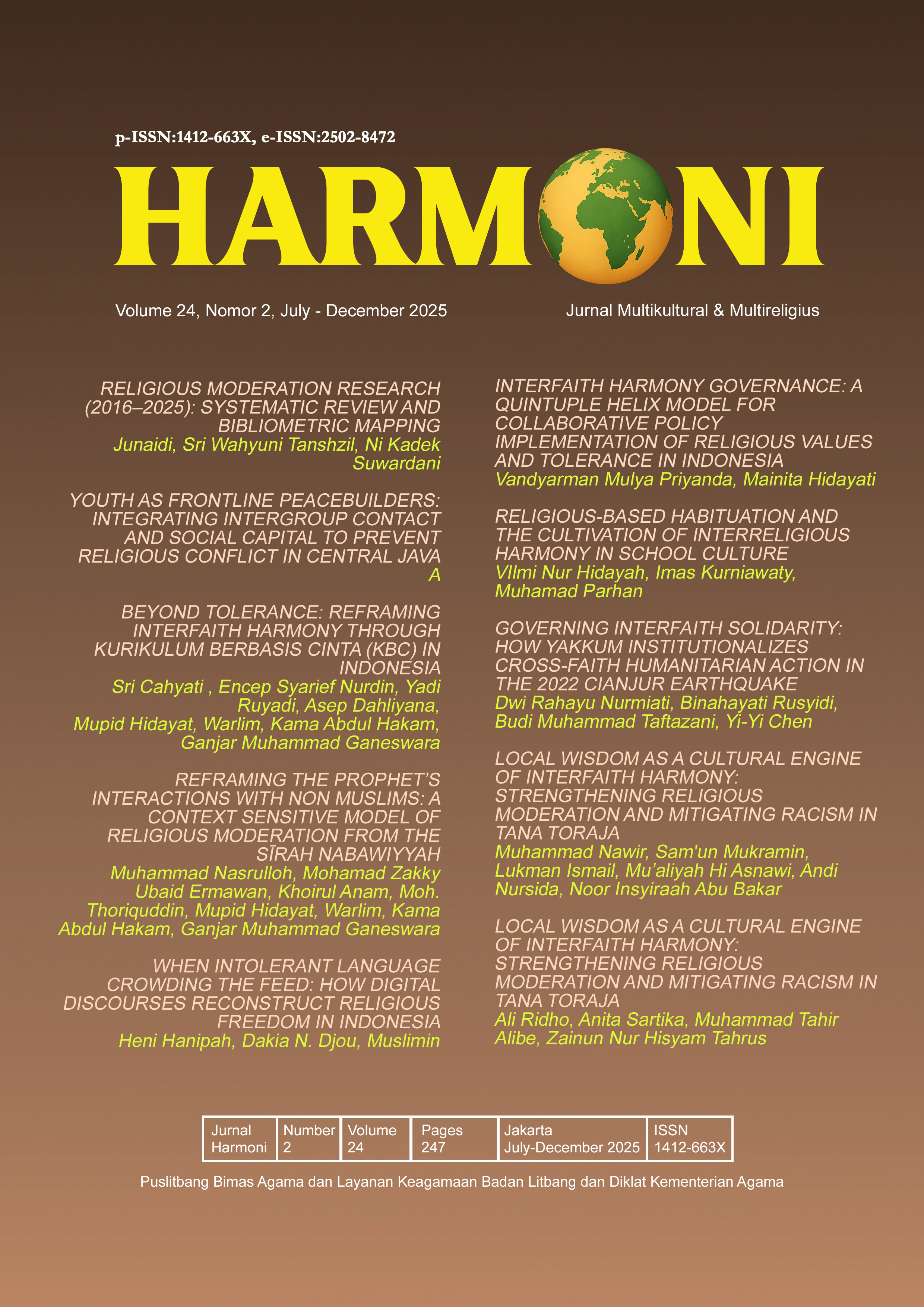
MINISTRY BEYOND TOLERANCE: REFRAMING INTERFAITH HARMONY THROUGH KURIKULUM BERBASIS CINTA (KBC) IN INDONESIA
DOI:
https://doi.org/10.32488/harmoni.v24i2.946Keywords:
Keywords: Love Curriculum, Ministry of Religious Affairs, education policy, humanistic education, religious moderation., Love Curriculum, Ministry of Religious Affairs, education policy, humanistic educationAbstract
Interfaith harmony remains a critical challenge in Indonesia’s plural society, where intolerance persists despite normative policy frameworks. Existing scholarship has rarely provided a systematic conceptual model linking Islamic compassion-based values to measurable indicators of harmony. Addressing this gap, this study examines the Ministry of Religious Affairs’ Kurikulum Berbasis Cinta (Love-Based Curriculum, KBC) and its relevance to strengthening tolerance, acceptance of difference, non-violence, and interreligious harmony. A qualitative descriptive design was employed, combining a systematic literature review of policy documents, peer-reviewed journal articles, and theoretical works. Data were extracted using a structured template and coded deductively around the values of mahabbah, rahmah, and amanah, and inductively to capture emergent themes. The analysis followed PRISMA guidelines to ensure transparency and rigor. Findings indicate three key contributions. First, KBC provides a coherent normative foundation that integrates spiritual, social, and ecological dimensions of education. Second, the values of mahabbah and rahmah are conceptually linked to empathy, tolerance, and conflict resolution, while amanah reinforces ecological responsibility and shared moral accountability. Third, the framework demonstrates that religious moderation can emerge as an outcome of KBC, moving beyond doctrinal instruction toward dialogical and inclusive practices. This study concludes that KBC offers a novel conceptual framework for embedding affective and ethical values into education. Future research should empirically test its implementation to assess its effectiveness in fostering sustainable interfaith harmony and social cohesion.
ABSTRAK
Kerukunan antarumat beragama tetap menjadi tantangan krusial dalam masyarakat majemuk Indonesia, di mana intoleransi masih bertahan meskipun telah tersedia kerangka kebijakan normatif. Kajian sebelumnya jarang menyajikan model konseptual yang sistematis yang menghubungkan nilai-nilai berbasis cinta dalam Islam dengan indikator harmoni yang terukur. Untuk mengisi kekosongan tersebut, penelitian ini menelaah Kurikulum Berbasis Cinta (KBC) yang digagas Kementerian Agama serta relevansinya dalam memperkuat toleransi, penerimaan perbedaan, anti-kekerasan, dan kerja sama antaragama. Penelitian ini menggunakan desain deskriptif kualitatif dengan tinjauan sistematis terhadap dokumen kebijakan, studi akademik dan karya teoretis. Data diekstraksi menggunakan templat terstruktur dan dikodekan secara deduktif berdasarkan nilai mahabbah, rahmah, dan amanah, serta secara induktif untuk menangkap tema-tema baru. Analisis mengikuti pedoman PRISMA guna memastikan transparansi dan ketelitian. Temuan menunjukkan tiga poin utama. Pertama, Kurikulum Berbasis Cinta menyediakan landasan normatif yang koheren dengan mengintegrasikan dimensi spiritual, sosial, dan ekologis pendidikan. Kedua, nilai mahabbah dan rahmah terkait secara konseptual dengan empati, toleransi dan resolusi konflik; sedangkan amanah memperkuat tanggung jawab ekologis dan akuntabilitas moral bersama. Ketiga, kerangka ini menunjukkan bahwa moderasi beragama dapat muncul sebagai hasil dari pedagogi berbasis cinta, melampaui pengajaran doktrinal menuju praktik dialogis dan inklusif. Penelitian ini menyimpulkan bahwa Kurikulum Berbasis Cinta menawarkan kerangka konseptual baru untuk mengintegrasikan nilai afektif dan etis dalam pendidikan. Penelitian lanjutan perlu menguji implementasinya secara empiris guna menilai efektivitasnya dalam membangun kerukunan antarumat beragama dan kohesi sosial yang berkelanjutan.
Downloads
References
REFERENCES
Aneas, A. (2024). Speak Catalan to Me, I’m a Catalan Muslim Woman: Producing Proposals for Religious and Education Policy through Participatory Research from a Gender Perspective. Religions, 15(2). https://doi.org/10.3390/rel15020141
Aure, P. A. H. (2025). Action research as a creative teaching method for humanistic management education: A case study of undergraduate business students. International Journal of Management Education, 23(2). https://doi.org/10.1016/j.ijme.2025.101179
Bers, M. U. (2025). Computer science education as a humanistic endeavor: A model for designing technology-rich formative experiences. Education and Information Technologies, 30(15), 21519–21550. https://doi.org/10.1007/s10639-025-13623-4
Brink, S. C. (2025). Curriculum Agility Principles for Transformative Innovation in Engineering Education. European Journal of Engineering Education, 50(3), 455–471. https://doi.org/10.1080/03043797.2024.2398165
Carlson, M. P. (2024). Considering, Piloting, Scaling and Sustaining a Research-Based Precalculus Curriculum and Professional Development Innovation. Journal of Mathematical Behavior, 73. https://doi.org/10.1016/j.jmathb.2024.101126
Cho, J. (2023). Religious Education in Catholic Schools in Ireland and South Korea: Complex Layers of Diversity, Policy and Teacher Agency. Irish Educational Studies, 42(4), 1009–1024. https://doi.org/10.1080/03323315.2023.2261431
Direktorat Jenderal Pendidikan Islam. (2025). Keputusan Direktur Jenderal Pendidikan Islam Nomor 6077 Tahun 2025 tentang Panduan Kurikulum Berbasis Cinta. Jakarta: Kementerian Agama Republik Indonesia.
Docking, S. (2025). Curriculum Innovation. In Curriculum in Nursing Education (pp. 149–163). https://doi.org/10.4324/9781003626008-7
Dröse, J. (2025). How Curriculum Materials Can Contribute to Implementing Instructional Innovations: The Case of Enactment of Strategy Instruction. ZDM Mathematics Education, 57(5), 1019–1034. https://doi.org/10.1007/s11858-025-01662-7
Fauzi, M. R. (2024). Islamic Religious Education Curriculum Innovation: Fethullah Gülen's Perspective. Jurnal Pendidikan Agama Islam, 21(1), 186–200. https://doi.org/10.14421/jpai.v21i1.7089
Hanafi, R. (2025). Islamic Religious Education and State School Policies in France and Senegal. British Journal of Religious Education. https://doi.org/10.1080/01416200.2025.2474518
Hendek, A. (2024). Teacher Training for Religious Education in Türkiye: Policy, Debate, and Diversity. Religions, 15(12). https://doi.org/10.3390/rel15121486
Joben, R., et al. (2025). Implementasi Kebijakan Pendidikan Islam di Indonesia: Studi atas Kinerja Kementerian Agama. Jurnal Lektur Keagamaan, 22(1), 97–122.
Kondrla, P. (2023). The Philosophical Context of Curriculum Innovations with a Focus on Competence Development. Journal of Education Culture and Society, 14(2), 78–92. https://doi.org/10.15503/jecs2023.2.78.92
Korhonen, T. (2023). Finnish Teachers as Adopters of Educational Innovation: Perceptions of Programming as a New Part of the Curriculum. Computer Science Education, 33(1), 94–116. https://doi.org/10.1080/08993408.2022.2095595
Lapis, G. (2025). The Theme of Social Cohesion in Religious Education Policies and Practices: An Analysis of England, Japan, and Italy. Religions, 16(4). https://doi.org/10.3390/rel16040503
Liu, Y. (2024). Research on Curriculum Civic Education and Innovation and Entrepreneurship Education Reform in Undergraduate Universities under the Web-Based Teaching Collaboration Platform. Applied Mathematics and Nonlinear Sciences, 9(1). https://doi.org/10.2478/amns.2023.1.00382
Londoño-Correa, D. (2025). A Humanistic Manager? Integrating Humanities into Professional Management Education in Colombia: The Case of Eafit University, 1994–2007. Journal of Management History, 31(1), 154–173. https://doi.org/10.1108/JMH-10-2023-0110
Lu, J. (2025). Design and Teaching Practice of Humanistic Care in Nursing Courses in Education for Undergraduate Students. Chinese Journal of Nursing Education, 22(3), 288–293. https://doi.org/10.3761/j.issn.1672-9234.2025.03.006
Mardhiah, A. (2025). Legal Implementation of Religious Moderation Policy at State Islamic Higher Education in Indonesia. Petita Jurnal Kajian Ilmu Hukum dan Syariah, 10(1), 179–194. https://doi.org/10.22373/petita.v10i1.417
Muhlisin. (2023). Navigating the Nexus: Government Policies in Cultivating Religious Moderation within State Islamic Higher Education. Qudus International Journal of Islamic Studies, 11(1), 207–236. https://doi.org/10.21043/qijis.v11i1.12677
Qoumas, Y. C. (2024). The Dissemination of Religious Moderation through the Policy of the Indonesian Ministry of Religious Affairs. Qudus International Journal of Islamic Studies, 12(1), 147–176. https://doi.org/10.21043/qijis.v12i1.27552
Rosanawati, I. M. R. (2025). Pedagogical Model Innovation Based on Ki Hajar Dewantara’s Among System for History Learning in the Merdeka Curriculum. Educational Process International Journal, 14. https://doi.org/10.22521/edupij.2025.14.39
Roberts, F. B. (2025). ANTi-Microhistory of Social Innovation: Humanistic Education at Robert Owen’s New Harmony Experiment. Journal of Management History, 31(3), 543–561. https://doi.org/10.1108/JMH-05-2023-0055
Sarkissian, A. (2024). Benign Bureaucracies? Religious Affairs Ministries as Institutions of Political Control. Democratization, 31(6), 1160–1182. https://doi.org/10.1080/13510347.2023.2293147
Singh, B. (2024). Curriculum Design in the Crossroads at Higher Education Institutions (HEIs) Boosting Quality Assurance: Satelliting Intellectual Property, Innovation – Legal Landscape. In Best Practices and Strategies for Online Instructors: Insights from Higher Education Online Faculty (pp. 497–526). https://doi.org/10.4018/979-8-3693-4407-1.ch018
Southworth, J. (2023). Developing a Model for AI Across the Curriculum: Transforming the Higher Education Landscape via Innovation in AI Literacy. Computers and Education Artificial Intelligence, 4. https://doi.org/10.1016/j.caeai.2023.100127
Stek, K. (2025). Rethinking Purchasing and Supply Management Education for Sustainability and Innovation Challenges: Crafting a Future-Ready Competency-Based Curriculum Design. Journal of Purchasing and Supply Management, 31(2). https://doi.org/10.1016/j.pursup.2024.100974
Tamburini, F. (2024). The “Authentic Islam” on the Internet: The Official Websites of the Ministries of Religious Affairs in Algeria, Morocco, and Tunisia. Journal of Asian and African Studies. https://doi.org/10.1177/00219096241295633
Tobroni. (2024). Legal Framework Analysis of Islamic Religious Education Policy Implementation. International Journal of Law and Society, 3(3), 217–237. https://doi.org/10.59683/ijls.v3i3.143
Ubisi, L. (2023). A Comparative Analysis between the Religious and Comprehensive Sexuality Education Policies in South African Schools. Journal of LGBT Youth, 20(1), 112–128. https://doi.org/10.1080/19361653.2021.1875282
Petticrew, M., & Roberts, H. (2006). Systematic reviews in the social sciences: A practical guide. Blackwell Publishing
Wahidi, R. (2024). Characteristics and Preservation of the Kamus Mu'jam Al-Qur’an Manuscript: A Study of the Manuscript in the Ministry of Religious Affairs Collection. Jurnal Lektur Keagamaan, 22(1), 97–122. https://doi.org/10.31291/jlka.v22i1.1214
Weishar, K. (2025). A Humanistic, Solution-Focused Approach to Meeting the Challenges in Education. In Coaching for Person-Centred Healthcare: A Solution Focused Approach to Collaborative Care (pp. 126–135). https://doi.org/10.4324/9781003414490-19
Wood, J. (2023). Developing Textile Sustainability Education in the Curriculum: Pedagogical Approaches to Material Innovation in Fashion. International Journal of Fashion Design Technology and Education, 16(2), 141–151. https://doi.org/10.1080/17543266.2022.2131913
Xin, Y. (2024). Diversified Curriculum Innovation of College Music Education under Deep Learning Model. Applied Mathematics and Nonlinear Sciences, 9(1). https://doi.org/10.2478/amns.2023.2.01102
Ye, J. (2025). Enhancing Staff Satisfaction through E-Learning: A Humanistic Focus on Development in Higher Education. International Conference on Higher Education Advances, 142–148. https://doi.org/10.4995/HEAd25.2025.20267
Downloads
Published
Issue
Section
License
Copyright (c) 2025 Sri Cahyati, Encep Syarief Nurdin, Yadi Ruyadi, Asep Dahliyana, Mupid Hidayat, Warlim, Kama Abdul Hakam, Ganjar Muhammad Ganeswara

This work is licensed under a Creative Commons Attribution-NonCommercial-ShareAlike 4.0 International License.