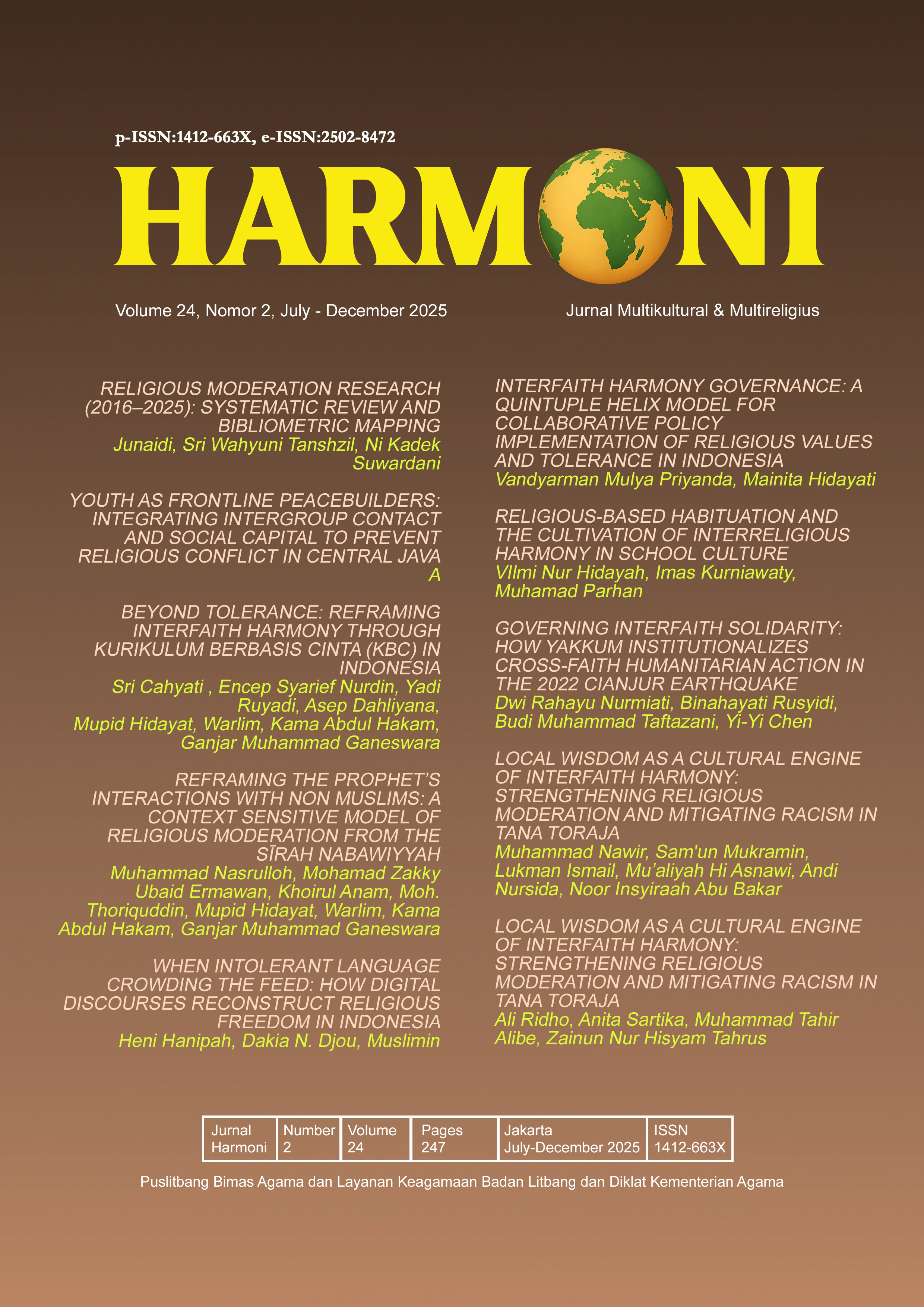
INTERFAITH HARMONY GOVERNANCE: A QUINTUPLE HELIX MODEL FOR COLLABORATIVE POLICY IMPLEMENTATION OF RELIGIOUS VALUES AND TOLERANCE IN INDONESIA
DOI:
https://doi.org/10.32488/harmoni.v24i2.927Keywords:
Pancasila, Religius, Toleransi, Kerukunan Antar Umat Beragama, Implementasi Kebijakan, Quintuple Heliks (QH)Abstract
This study addresses a critical gap in the literature on interfaith harmony in Indonesia, where existing research predominantly emphasizes normative principles of Pancasila while offering limited analytical models that map multi‑actor collaboration in policy implementation. The purpose of this study is to develop a conceptual framework for collaborative policy implementation using the Quintuple Helix model to strengthen the institutionalization of religious values and tolerance. A qualitative research design was employed, drawing on policy documents and academic literature published between 2000 and 2025. Data were analyzed through systematic literature review procedures, including screening, thematic coding, and conceptual synthesis. The analysis was guided by the Quintuple Helix framework to identify actor roles, interaction patterns, and governance mechanisms. The findings reveal three key insights. First, effective promotion of religious values and tolerance requires coordinated engagement among government, academia, civil society, the private sector, and media. Second, the state remains the primary driver of interfaith harmony, yet non‑state actors contribute essential knowledge, social capital, and communication functions. Third, existing governance arrangements remain fragmented, indicating the need for a more integrated collaborative model. These findings imply that interfaith harmony policies must shift from normative dissemination toward structured multi‑actor governance. The study concludes by proposing a Quintuple Helix–based model that offers theoretical advancement in religious harmony governance and practical guidance for policymakers designing collaborative interfaith programs.
Abstrak
Penelitian ini mengisi kesenjangan penting dalam studi mengenai kerukunan antarumat beragama di Indonesia, di mana studi terdahulu lebih banyak menekankan prinsip normatif Pancasila dan belum menyediakan model analitis yang memetakan kolaborasi multiaktor dalam implementasi kebijakan. Tujuan artikel ini adalah mengembangkan kerangka konseptual untuk implementasi kebijakan kolaboratif dengan menggunakan model Quintuple Helix guna memperkuat internalisasi nilai-nilai keagamaan dan toleransi. Penelitian ini menggunakan desain kualitatif dengan memanfaatkan dokumen kebijakan dan literatur akademik yang terbit antara tahun 2000 hingga 2025. Data dianalisis melalui prosedur tinjauan pustaka sistematis, termasuk penyaringan, pengodean tematik, dan sintesis konseptual. Analisis dipandu oleh kerangka Quintuple Helix untuk mengidentifikasi peran aktor, pola interaksi, dan mekanisme tata kelola. Temuan penelitian menunjukkan tiga hal utama. Pertama, promosi nilai keagamaan dan toleransi yang efektif memerlukan keterlibatan terkoordinasi antara pemerintah, akademisi, masyarakat sipil, sektor swasta, dan media. Kedua, negara tetap menjadi penggerak utama kerukunan antarumat beragama, namun aktor non-negara menyediakan kontribusi penting berupa pengetahuan, modal sosial, dan fungsi komunikasi. Ketiga, pengaturan tata kelola yang ada masih terfragmentasi sehingga memerlukan model kolaboratif yang lebih terintegrasi. Temuan ini mengimplikasikan perlunya pergeseran kebijakan kerukunan dari pendekatan normatif menuju tata kelola multiaktor yang terstruktur. Studi ini menyimpulkan dengan menawarkan model berbasis Quintuple Helix yang memberikan kontribusi teoretis bagi tata kelola kerukunan beragama serta panduan praktis bagi pembuat kebijakan dalam merancang program kolaboratif lintas aktor.
Downloads
References
Adawiyah, R. Al, Tobing, C. I., & Handayani, O. (2021). Understanding of Religious Moderation and Intolerant Behavior of Teenagers in Big Cities in West Java. Jurnal Keamanan Nasional, 6(2), 161–183. https://doi.org/10.31599/jkn.v6i2.470
Akbaba, Y., & Fox, J. (2018). Societal Rather than Governmental Change: Religious Discrimination in Muslim-Majority Countries after the Arab Uprisings. All Azimuth: A Journal of Foreign Policy and Peace. https://doi.org/10.20991/allazimuth.424929
Ali, M., Sofyan, M. A., & Arenggoasih, R. W. (2020). Contestation Behind Tolerance: Between Competition and Tolerance In The Discourse Of Multiculturalism In Salatiga. Jurnal Ilmiah Islam Futura, 20(2), 166. https://doi.org/10.22373/jiif.v0i0.5835
Ansell, C., & Gash, A. (2008). Collaborative Governance in Theory and Practice. Journal of Public Administration Research and Theory, 18(4), 543–571. https://doi.org/10.1093/jopart/mum032
Armas, K. L., & Villegas, M. N. (2025). Partnerships for Sustainable Development: a Quintuple Helix Framework for Research, Innovation, and Extension in Philippine State Universities. Journal of Lifestyle and SDGs Review, 5(2), e03158. https://doi.org/10.47172/2965-730X.SDGsReview.v5.n02.pe03158
As’ari, H., Maksum, I. R., Rosdiana, H., Kusumastuti, H. R., Mayarni, & Handoko, T. (2021). Policy design of government affairs distribution in the future forestry sector: A study in Indonesia. International Journal of Sustainable Development and Planning, 16(5), 801–810. https://doi.org/10.18280/ijsdp.160501
Ashfiya, D. A. N. (2025). Kasus Intoleransi di Indonesia: Jumlah, Penyebab, Pelaku dan Contohnya. Retrieved July 10, 2025, from https://goodstats.id/article/intoleransi-agama-di-indonesia-HdiJw
Asrinaldi, Yusoff, M. A., & Karim, dan Z. A. (2022). Oligarchy in the Jokowi government and its influence on the implementation of legislative function in Indonesia. Asian Journal of Comparative Politics, 7(2), 189–203. https://doi.org/10.1177/2057891121995564
Barros, A. T. de, & Lemos, C. R. F. (2019). Media Parliament: analysis of the schedule of Brazilian congress TV channel from the standpoint of members, mediamakers and the public. Observatorio (OBS*), 13(4), 107–130. https://doi.org/10.15847/obsobs13420191114
Blum, L. (2014). Three educational values for a multicultural society: Difference recognition, national cohesion and equality. Journal of Moral Education, 43(3), 332–344. https://doi.org/10.1080/03057240.2014.922057
Borrero, J. D., & Yousafzai, S. (2024). Circular entrepreneurial ecosystems: a Quintuple Helix Model approach. Management Decision, 62(13), 141–177. https://doi.org/10.1108/MD-08-2023-1361
Boucher, F., & Laborde, C. (2016). Why Tolerate Conscience? Criminal Law and Philosophy, 10(3), 493–514. https://doi.org/10.1007/s11572-014-9325-2
Budiman, A. (2012). Otonomi Daerah, Penguatan Politik Identitas Dan Pengaruhnya Terhadap Integrasi Nasional. SAWALA: Jurnal Administrasi Negara, 1(1), 1–10. https://doi.org/https://doi.org/10.30656/sawala.v1i1.298
Carayannis, E. G., Barth, T. D., & Campbell, D. F. (2012). The Quintuple Helix innovation model: global warming as a challenge and driver for innovation. Journal of Innovation and Entrepreneurship, 1(1), 2. https://doi.org/10.1186/2192-5372-1-2
Carayannis, E. G., & Campbell, D. F. J. (2010). Triple Helix, Quadruple Helix and Quintuple Helix and How Do Knowledge, Innovation and the Environment Relate To Each Other? International Journal of Social Ecology and Sustainable Development, 1(1), 41–69. https://doi.org/10.4018/jsesd.2010010105
Carmona, S., & Silva, C. P. (2020). How do environmental impact assessments fail to prevent social conflict? Government technologies in a dam project in Colombia. Journal of Political Ecology, 27(1), 1073–1091. https://doi.org/10.2458/V27I1.23223
Chaoui, A., Rebija, K., Chkaiti, K., Laaouan, M., Bourziza, R., Sebari, K., & Elkhoumsi, W. (2023). Applications of Missing Data Imputation Methods in Wastewater Treatment Plants. International Journal of Advanced Computer Science and Applications, 14(10). https://doi.org/10.14569/IJACSA.2023.0141049
Dharmapala, A., Dewi, S. A. K., & Iswahyudi, G. (2022). Penguatan Dewan Perwakilan Daerah Terkait Fungsi Legislasi dalam Perspektif Demokrasi Deliberatif. AL-MANHAJ: Jurnal Hukum Dan Pranata Sosial Islam, 4(2), 307–318. https://doi.org/10.37680/almanhaj.v4i2.1865
Diamantina, A. (2018). Duties and Functions of the Complementary Organs as Performance Support of the Regional Representative Council. IOP Conference Series: Earth and Environmental Science, 175(1). https://doi.org/10.1088/1755-1315/175/1/012167
Djumala, D. (2013). Soft Power for Aceh: Conflict Resolution and Decentralization Politics (1st ed.). Jakarta: PT. Gramedia Pustaka Utama.
Duffy, M. M., Binder, A. J., & Skrentny, J. D. (2010). Elite status and social change: Using field analysis to explain policy formation and implementation. Social Problems, 57(1), 49–73. https://doi.org/10.1525/sp.2010.57.1.49
Duile, T., & Kennex Aldama, P. (2024). Seeing Through the Lens of Atheism: Plural Societies, Religion, and Harmony Ideology in Southeast Asia. Secularism & Nonreligion, 13(4), 1–11. https://doi.org/https://doi.org/10.5334/snr.173
Emerson, K., & Nabatchi, T. (2015). Evaluating the Productivity of Collaborative Governance Regimes: A Performance Matrix. Public Performance & Management Review, 38(4), 717–747. https://doi.org/10.1080/15309576.2015.1031016
Febriyana, D., Octaviani, N., Anggraeni, T., & Fitriono, R. A. (2022). Implementasi Pancasila Terhadap Kasus Korupsi yang Terjadi di Indonesia. Gema Keadilan, 9(3). https://doi.org/10.14710/gk.2022.16421
Fenton, A. J. (2024). The Pancasila Ideological Direction Bill (RUU‐HIP): A Missed Opportunity? Politics and Governance, 12. https://doi.org/10.17645/pag.7672
Fischer, F., Miller, G. J., & Sidney, M. S. (2006). Handbook of public policy. Handbook of Public Policy. CRC Press. https://doi.org/10.4135/9781848608054
Grindle, M. S. (1980). Politics and Policy Implementation in the Third World. (M. S. GRINDLE, Ed.). Princeton University Press.
Grindle, M. S. (2017). The implementor: Political constraints on rural development in Mexico. In Politics and Policy Implementation in the Third World (pp. 197–223). https://doi.org/10.1515/9781400886081-012
Hanif, M., Mukhroji, Suwito, H., Mubaroq, A. C., & Dharin, A. (2024). Pesantren Resistance to Indonesia’s National Curriculum to Defend Its Curriculum Model. Revista de Gestão Social e Ambiental, 18(7), e05473. https://doi.org/10.24857/rgsa.v18n7-049
Haryani, E. (2019). Intoleransi Dan Resistensi Masyarakat Terhadap Kemajemukan: Studi Kasus Kerukunan Beragama Di Kota Bogor, Jawa Barat. Harmoni, 18(2), 282–298. https://doi.org/https://doi.org/10.32488/harmoni.v18i2.405
Hidayat, D. S., Sensuse, D. I., Elisabeth, D., Hasani, L. M., & Widyarto, S. (2022). Conceptual Model of Knowledge Management System for Scholarly Publication Cycle in Academic Institution. VINE Journal of Information and Knowledge Management Systems. https://doi.org/https://doi.org/10.1108/VJIKMS-08-2021-0163
Hynson, M. (2021). A Balinese ‘Call to Prayer’: Sounding Religious Nationalism and Local Identity in the Puja Tri Sandhya. Religions, 12(8), 668. https://doi.org/10.3390/rel12080668
Jamaludin, A. N. (2021). Cities and villages in the religious conflict circle: Socio-demographic factors of communal and sectarian conflict in west java, indonesia. HTS Teologiese Studies / Theological Studies, 77(4), 1–7. https://doi.org/10.4102/HTS.V77I4.6854
Jha, P. (2007). Indonesia: Vulnerabilities and strengths of a regional power. India Quarterly, 63(1), 111–136. https://doi.org/10.1177/097492840706300105
Kamali Saraji, M., & Streimikiene, D. (2023). Challenges to the low carbon energy transition: A systematic literature review and research agenda. Energy Strategy Reviews, 49, 101163. https://doi.org/10.1016/j.esr.2023.101163
Khalikin, A. (2014). Penanganan Potensi Konflik Keagamaan Di Cigugur Kabupaten Kuningan. Harmoni, 13(3), 139–152. https://doi.org/https://doi.org/10.32488/harmoni.v13i3.119
Khoiron, M. (2019). Represi Yang Gagal: Relasi Negara Dan Jemaat Ahmadiyah Di Tingkat Lokal. Harmoni, 18(1), 408–423. https://doi.org/10.32488/harmoni.v18i1.351
Kipo-Sunyehzi, D. D. (2022). Perspectives on Public Policy Implementation in Developing World Context: The Case of Ghana’s Health Insurance Scheme. Public Organization Review, 22(3), 611–626. https://doi.org/10.1007/s11115-021-00520-w
Kitchenham, B., & Charters, S. (2007). Guidelines for performing systematic literature reviews in software engineering EBSE Technical Report EBSE-2007-01. Keele University, Keele, UK.
Kumalasari, E. D., Latifa, I., Aminarsih, R., Damayanti, F. F., & Mubarok, Z. I. (2022). Religious Conflict in Indonesia: Crisis of Tolerance and Violations of Human Rights Against Ahmadiyah. Education, Social Sciences and Humanities Journal, 6(2), 53–61. https://doi.org/https://doi.org/10.26740/metafora.v6n2.p53-61
Lathifah, A., Hapsin, A.-, Rofiq, A., & Hidayatullah, M. A. (2022). The Construction of Religious Freedom in Indonesian Legislation: A Perspective of Maqāṣid Ḥifẓ Al-Dīn. Samarah: Jurnal Hukum Keluarga Dan Hukum Islam, 6(1), 369. https://doi.org/10.22373/sjhk.v6i1.10957
Marta, A., Asrida, W., Amin, R. M., Febrina, R., & Harirah, Z. (2024). Pentahelix collaboration on environmental perspective: Handling underdeveloped villages in conservation forests. E3S Web of Conferences, 506, 05006. https://doi.org/10.1051/e3sconf/202450605006
Matsiliza, N. S. (2019). Strategies to Improve Capacity for Policy Monitoring and Evaluation in the Public Sector. Journal of Reviews on Global Economics, 8, 490–499. https://doi.org/10.6000/1929-7092.2019.08.42
McClintock, C. (2017). Reform governments and policy implementation: Lessons from Peru. In Politics and Policy Implementation in the Third World (pp. 64–97). https://doi.org/10.1515/9781400886081-007
Merino-Barbancho, B., Abril Jiménez, P., Mallo, I., Lombroni, I., Cea, G., López Nebreda, C., … Arredondo, M. T. (2023). Innovation through the Quintuple Helix in living labs: lessons learned for a transformation from lab to ecosystem. Frontiers in Public Health, 11. https://doi.org/10.3389/fpubh.2023.1176598
Modood, T., & Sealy, T. (2025). The governance of religious diversity: A comparative-normative exercise. Ethnicities, 25(5), 762–769. https://doi.org/10.1177/14687968251353686
Morrow, E. V., Kabala, B. Z., & Hartness, C. D. (2023). Between Public Justification and Civil Religion: Shared Values in a Divided Time. Religions, 14(2), 133. https://doi.org/10.3390/rel14020133
Mudzakkir, A. (2017). Konservatisme Islam Dan Intoleransi Keagamaan Di Tasikmalaya. Harmoni, 16(1), 57–74. https://doi.org/https://doi.org/10.32488/harmoni.v16i1.56
Mukhlis, F. H. (2016). Teologi Pancasila: Teologi Kerukunan Umat Beragama. FIKRAH, 4(2), 171. https://doi.org/10.21043/fikrah.v4i2.1885
Mulyadi & Prakoso, L. Y. (2021). Optimalisasi Nilai-Nilai Pancasila di Era VUCA Perspektif Strategi Perang Semesta. Inovasi Penelitian, 2(2), 415–426.
Muqsith, M. A., Muzykant, V. L., Tayibnapis, R. G., & Pratomo, R. R. (2022). Revolutionizing Pancasila as the ideology of Indonesians. RUDN Journal of Sociology, 22(4), 860–871. https://doi.org/10.22363/2313-2272-2022-22-4-860-871
Nakaya, A. (2018). Overcoming Ethnic Conflict through Multicultural Education: The Case of West Kalimantan, Indonesia. International Journal of Multicultural Education, 20(1), 118–137. https://doi.org/10.18251/ijme.v20i1.1549
Netanyahu, K., & Susanto, D. (2022). The Sustainability of Interreligious Dialogue in Indonesia under the Phenomenon of Intolerance by Islamic Populists. Dialog, 45(2), 248–257. https://doi.org/https://doi.org/10.47655/dialog.v45i2.664
Nte, N. D., Teru, V. A., & Putri, N. M. (2022). Intelligence education for national security and public safety policy: A comparative analysis of nigeria, south africa, and indonesia. Lex Scientia Law Review, 6(1), 187–218. https://doi.org/10.15294/lesrev.v6i1.54431
Nugroho, A., & Maulana, D. (2020). Pemenuhan Elemen Necessary Conditions Kecamatan Dalam Penyelenggaraan Pemerintahan Umum di Kabupaten Pandeglang. Kebijakan Pembangunan Daerah, 4(2), 129–146.
Nulhaqim, S. A., & Adiansah, W. (2023). Implementation of Social Conflict Management Programs in Sumedang Regency by the Sumedang Regency National and Political Unity Office. Wseas Transactions On Environment And Development, 19, 1058–1070. https://doi.org/10.37394/232015.2023.19.100
Nurdianzah, E., Azizah, N., Rahmawati, R., Munib, A., Sulistyowati, O. H., & Albary, H. (2024). Pancasila as State Ideology and Pillar of Religious Harmony in Indonesian Society. Islamic Review: Jurnal Riset Dan Kajian Keislaman, 13(2), 129–142. https://doi.org/https://doi.org/10.35878/islamicreview.v13i2.1201
Nurdin, E. S. (2017). Civic Education policies: Their effect on university students’ spirit of nationalism and patriotism. Citizenship, Social and Economics Education, 16(1), 69–82. https://doi.org/10.1177/2047173416688039
Nurman, Yusriadi, Y., & Hamim, S. (2022). Development of Pluralism Education in Indonesia: A Qualitative Study. Journal of Ethnic and Cultural Studies, 9(3), 106–120. https://doi.org/10.29333/ejecs/1207
Prihastuti, D. (2022). Tinjauan Yuridis Desentralisasi dan Otonomi Daerah dalam Proses Pemerintahan Dikaitkan Undang-Undang 23 Tahun 2014 tentang Pemerintah Daerah. Jurnal Legislasi Indonesia, 19(1), 29–41.
Prihatiningsih, M. D., Deliarnoor, N. A., & Hermawati, R. (2024). Collaborative Governance dalam Mewujudkan Kota Singkawang Sebagai Kota Tertoleran Tahun 2023. Ganaya : Jurnal Ilmu Sosial Dan Humaniora, 7(4), 324–340. https://doi.org/10.37329/ganaya.v7i4.3496
Priyanda, V. M. (2011). Strategi Pemerintah Kota Bekasi Dalam Mengatasi Konflik Sosial (Studi Kasus: Bakesbangpolinmas Kota Bekasi). FISIP UI. Universitas Indonesia.
Priyanda, V. M. (2019). Administrative Reform Di Sektor Pemerintahan Sebagai Pra- Kondisi Kemunculan Aktor-Aktor Social Entrepreneurship (Penelaahan Terhadap Pendekatan New Public Management). Reformasi Administrasi, 6(2), 124–132.
Priyanda, V. M., Ningrum, S., Buchari, A., & Alamsyah, N. (2023). Inconsistency in Implementing General Government Affairs in Bekasi City (Implementing the Program of National Vigilance and Facilitation of Social Conflict Resolution 2015-2022). Journal of Hunan University Natural Sciences, 50(5), 83–99. https://doi.org/10.55463/issn.1674-2974.50.5.10
Priyanda, V. M., Ningrum, S., Buchari, R. A., & Deliarnoor, N. A. (2023). Deconcentration In Ten Years: A Systematic Mapping Study. Namibian Studies, 33, 4143–4161. Retrieved from https://namibian-studies.com/index.php/JNS/article/view/2013/1849
Pylypenko, V., Bondarenko, S., Kolisnichenko, R., Runcheva, N., Gorniak, K., & Drobotov, S. (2022). Information And Analytical Support Threat Monitoring And Means Of Overcoming Challenges To National Security: International Legal Aspect. Trames. Journal of the Humanities and Social Sciences, 26(4), 373. https://doi.org/10.3176/tr.2022.4.02
Ribot, J. C. (2004). Waiting for Democracy: The Politics of Choice in Natural Resource Decentralization. (M. Schultz & E. Yaghmour, Eds.), Foreign Policy. Washington, D..C: World Resources Institute. https://doi.org/10.2307/1148781
Rizkiyani, F. (2018). Strengthening national identity through civic education for young children: A case study of Indonesia. International Journal of Engineering and Technology(UAE), 7(3), 291–294. https://doi.org/10.14419/ijet.v7i3.25.17584
Rofii, A. (2021). The Religiosity of the Indonesian Constitution: Article 29(1) and Its Interpretation. Constitutional Review, 7(2), 203. https://doi.org/10.31078/consrev722
Sabara, S. (2018). Kasus-Kasus Pembangunan Rumah Ibadat Pasca PBM Nomor 9 DAN 8 Tahun 2006 Di Provinsi Sulawesi Utara. Harmoni, 17(1), 27–40. https://doi.org/10.32488/harmoni.v17i1.268
Sadad, A. (2016). Manajemen Konflik Sosial Dan Upaya Penyelesaiannya. Administrasi Pembangunan, 4(2), 137–142.
Sagita, N. I. (2018). Implmentation Of General Public Affairs In Nurturing Religious Harmony By The Government Of Bandung City. Penamas, 31(1), 47. https://doi.org/10.31330/penamas.v31i1.180
Sandford, M. (2020). Giving power away? The ‘de- words’ and the downward transfer of power in mid-2010s England. Regional & Federal Studies, 30(1), 25–46. https://doi.org/10.1080/13597566.2019.1640682
Santagati, M. E., Bonini Baraldi, S., & Zan, L. (2020). Understanding decentralization: deconcentration and devolution processes in the French and Italian cultural sectors. International Journal of Public Sector Management, 33(4), 435–460. https://doi.org/10.1108/IJPSM-02-2019-0050
Santoni, M. B. (2018). Perilaku dan Kasus Intoleransi Masyarakat Dalam Lingkup Jawa Baratالبترول (pp. 1–11).
Sarkissian, A. (2009). Religious Reestablishment in Post-Communist Polities. Journal of Church and State, 51(3), 472–501. https://doi.org/10.1093/jcs/csp096
Sarkissian, Ani. (2015). The Varieties of Religious Repression. Oxford University Press. https://doi.org/10.1093/acprof:oso/9780199348084.001.0001
Silaban, P. S., Tarigan, S., & Hutagalung, Y. O. (2025). Pancasila Sebagai Sistem Etika: Menjaga Integritas Sosial Dan Budaya Dalam Kehidupan Berbangsa. Sindoro Cendikia Pendidikan, 13(5). https://doi.org/https://doi.org/10.9644/sindoro.v13i5.11918
Siregar, M. H., & Sahrul, S. (2022). Searching legal format: Reshaping the role of state and religion in Indonesia post-Suharto. HTS Teologiese Studies / Theological Studies, 78(1), 1–8. https://doi.org/10.4102/hts.v78i1.7922
Sujatmiko, I. G. (2012). Conflict transformation and social reconciliation: The case of aceh, Indonesia. Asian Social Science, 8(2), 104–111. https://doi.org/10.5539/ass.v8n2p104
Suparno. (2017). “Revolusi Mental” to build the character of bureaucrats in Indonesia. International Journal of Civil Engineering and Technology, 8(8), 1099–1104.
Sweinstani, K. D. M. (2016). The Politics of Education in South East Asia: A Comparative Study on Decentralization Policy in Primary Education in Indonesia and Thailand. International Journal of Social Science and Humanity, 6(11), 825–829. https://doi.org/10.18178/ijssh.2016.v6.757
Syam, F., Mangunjaya, F. M., Rahmanillah, A. R., & Nurhadi, R. (2020). Narrative and the politics of identity: Patterns of the spread and acceptance of radicalism and terrorism in indonesia. Religions, 11(6), 1–27. https://doi.org/10.3390/rel11060290
Ubaedillah, A. (2018). Civic Education for Muslim Students in the Era of Democracy: Lessons Learned from Indonesia. The Review of Faith & International Affairs, 16(2), 50–61. https://doi.org/10.1080/15570274.2018.1469837
Widianingsih, I., Abdilah, A., Adikancana, Q. M., Miftah, A. Z., Dewi, A. U., & RESNAWATY, R. (2024). Integrated Rural Development And Environment Issues In Indonesia: Is The Quintuple Helix Model Sustainable? (pp. 451–463). https://doi.org/10.2495/SDP240381
Widianingsih, I., Abdillah, A., Hartoyo, D., Putri, S. S. U., Miftah, A. Z., & Adikancana, Q. M. (2024). Increasing resilience, sustainable village development and land use change in Tarumajaya village of Indonesia. Scientific Reports, 14(1), 31831. https://doi.org/10.1038/s41598-024-82934-2
Yunanto, S. E. (2021). Government Making: Rebuilding Government Science. GOVERNABILITAS (Jurnal Ilmu Pemerintahan Semesta), 2(1), 1–20. https://doi.org/10.47431/governabilitas.v2i1.109
Zhou, N., Xiao, X., & Feng, F. (2014). Citizen Participation in the Public Policy Process in China: Based on Policy Network Theory. Public Administration Research, 3(2), 91–106. https://doi.org/10.5539/par.v3n2p91
Downloads
Published
Issue
Section
License
Copyright (c) 2025 Vandyarman Mulya Priyanda, Mainita Hidayati

This work is licensed under a Creative Commons Attribution-NonCommercial-ShareAlike 4.0 International License.