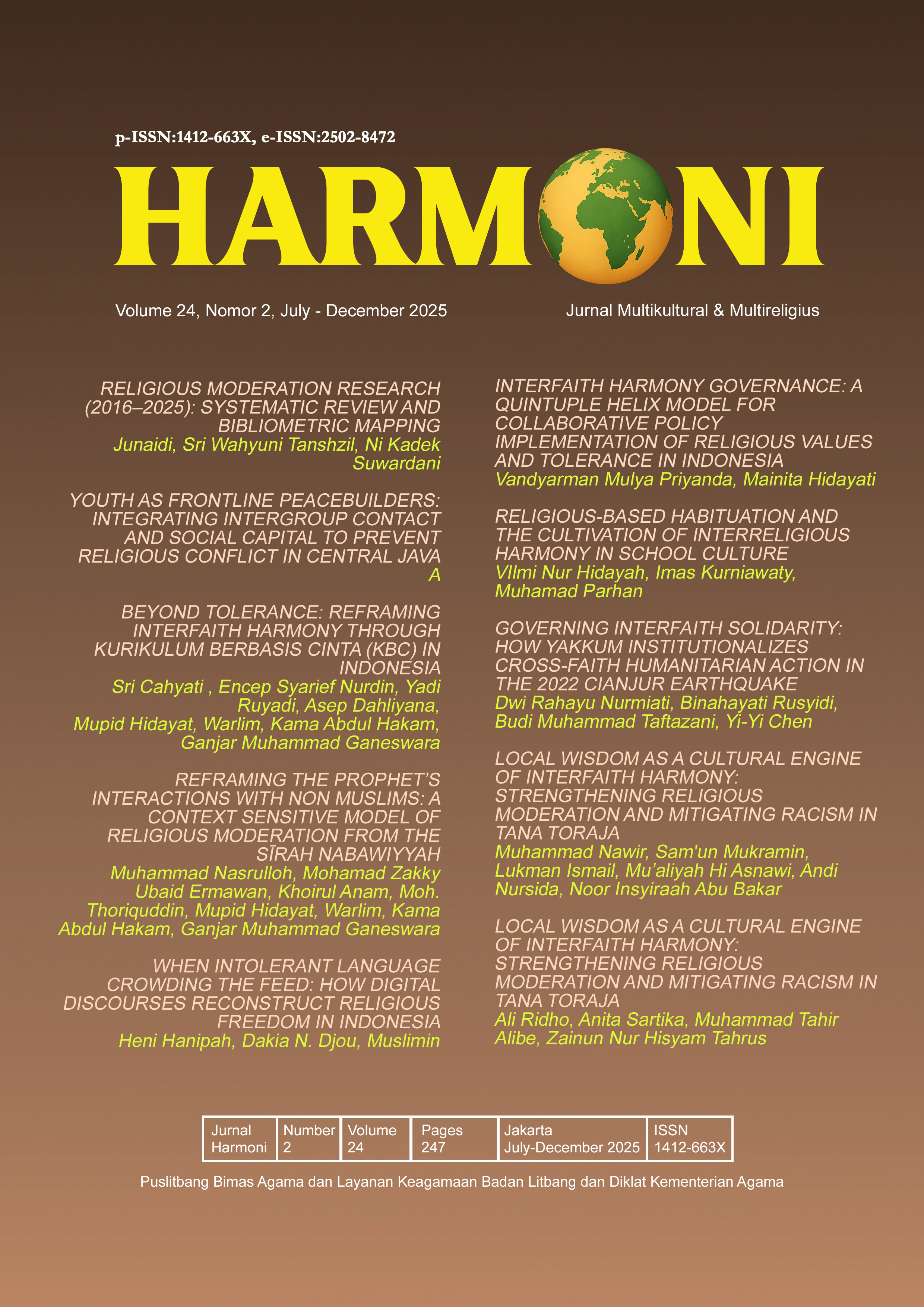
GOVERNING INTERFAITH SOLIDARITY: HOW YAKKUM INSTITUTIONALIZES CROSS-FAITH HUMANITARIAN ACTION IN THE 2022 CIANJUR EARTHQUAKE
DOI:
https://doi.org/10.32488/harmoni.v24i2.915Keywords:
Interfaith Solidarity, Post-Disaster Recovery, Humanitarian Governance, Intergroup Contact Theory, YAKKUM Emergency UnitAbstract
This study analyzes how interfaith solidarity is negotiated and institutionalized within post-disaster humanitarian governance, focusing on the interaction between the Christian-based YAKKUM Emergency Unit (YEU) and Muslim communities affected by the 2022 Cianjur earthquake in Indonesia. Adopting a sociological approach to religion and humanitarian governance, this research employed a qualitative, in-depth case study design to examine the socially embedded processes of legitimacy, cooperation, and moral negotiation in a religiously homogeneous setting. Data were collected through in-depth interviews with 24 informants, participatory observation across multiple emergency and recovery sites, and analysis of institutional and policy documents. They were analyzed using thematic analysis supported by NVivo 12 Plus. The findings identify four interrelated dimensions that enabled constructive interfaith engagement: equality of status between humanitarian actors and affected communities, shared humanitarian goals grounded in collective moral commitment, intergroup cooperation enacted through participatory practices, and institutional and normative support from state agencies and religious authorities. These dimensions demonstrate that interfaith solidarity in disaster contexts is not a spontaneous moral response, but an institutionalized social practice embedded within local cultural values such as gotong royong and universal compassion. The study contributes to the literature by extending Intergroup Contact Theory into a socio-normative and institutional framework, highlighting the role of cultural legitimacy and governance structures in shaping interfaith relations during crises. Practically, the findings offer empirically grounded insights for strengthening inclusive humanitarian governance and for developing capacity-building frameworks for faith-based organizations operating across religious boundaries in plural societies.
Abstrak
Penelitian ini bertujuan untuk menganalisis bagaimana solidaritas lintas iman dinegosiasikan dan diinstitusionalisasikan dalam tata kelola kemanusiaan pascabencana, dengan fokus pada interaksi antara YAKKUM Emergency Unit (YEU) yang berbasis Kristen dan komunitas Muslim terdampak gempa Cianjur tahun 2022. Dengan menggunakan pendekatan sosiologis terhadap agama dan tata kelola kemanusiaan, penelitian ini menerapkan desain studi kasus intrinsik kualitatif untuk menelaah proses sosial yang terlekat pada pembentukan legitimasi, kerja sama, dan negosiasi moral dalam konteks masyarakat yang relatif homogen secara keagamaan. Data dikumpulkan melalui wawancara mendalam terhadap 24 informan, observasi partisipatif pada berbagai lokasi tanggap darurat dan pemulihan, serta analisis dokumen kelembagaan dan kebijakan, yang kemudian dianalisis menggunakan analisis tematik dengan bantuan NVivo 12 Plus. Temuan penelitian menunjukkan empat dimensi yang saling berkaitan dalam membentuk interaksi lintas iman yang konstruktif, yaitu kesetaraan status antara aktor kemanusiaan dan masyarakat terdampak, tujuan kemanusiaan bersama yang berlandaskan komitmen moral kolektif, kerja sama antarkelompok yang diwujudkan melalui praktik partisipatif, serta dukungan institusional dan normatif dari negara dan otoritas keagamaan. Keempat dimensi tersebut menunjukkan bahwa solidaritas lintas iman dalam konteks kebencanaan bukanlah respons moral yang spontan, melainkan praktik sosial yang terinstitusionalisasi dan berakar pada nilai-nilai budaya lokal seperti gotong royong dan welas asih universal. Secara teoretis, penelitian ini berkontribusi dengan memperluas Teori Kontak Antarkelompok ke dalam ranah sosio-normatif dan institusional, dengan menekankan peran legitimasi budaya dan struktur tata kelola dalam membentuk relasi lintas iman pada situasi krisis. Secara praktis, temuan ini memberikan dasar empiris bagi penguatan tata kelola kemanusiaan yang inklusif serta pengembangan kerangka penguatan kapasitas bagi organisasi kemanusiaan berbasis iman yang beroperasi lintas batas keagamaan dalam masyarakat plural.
Downloads
References
Ager, J., Ager, A., & Rottmann, S. (2015). Faith, secularism, and humanitarian engagement. Journal of Refugee Studies, 28(4), 456–476.
Aldrich, D. P., & Meyer, M. A. (2015). Social capital and community resilience. American Behavioral Scientist, 59(2), 254–269. https://doi.org/10.1177/0002764214550299
Braun, V., & Clarke, V. (2006). Using thematic analysis in psychology. Qualitative Research in Psychology, 3(2), 77–101. https://doi.org/10.1191/1478088706qp063oa
Engkizar, E., Kaputra, S., Mutathahirin, M., Syafril, S., Arifin, Z., & Kamaluddin, M. (2022). Model pencegahan konflik antarumat beragama berbasis kegiatan masyarakat. Harmoni, 21(1), 110–129. https://doi.org/10.32488/harmoni.v21i1.603
Ferris, E. (2011). Faith and humanitarianism: It’s complicated. Journal of Refugee Studies, 24(3), 606–625. https://doi.org/10.1093/jrs/fer030
Fuller, T. J. (2025). Discourses of “religion” in public health research. SSM – Qualitative Research in Health, 8, 100618. https://doi.org/10.1016/j.ssmqr.2025.100618
Ghafory-Ashtiany, M. (2015). View of Abrahamic religions on natural disaster risk reduction. Hazards, Risks, and Disasters in Society, 373–390. https://doi.org/10.1016/B978-0-12-396451-9.00021-4
Hamdi, W. B., Aderibigbe, S. A., Idriz, M., & Alghfeli, M. M. (2024). Faith in humanity: Religious charitable organizations’ solidarity towards migrants in the UAE. Religions, 15(3), 266. https://doi.org/10.3390/rel15030266
Hefner, R. W. (2019). Islam, law, and political pluralism in Indonesia. Routledge.
Hewstone, M., Lolliot, S., Swart, H., Myers, E., Voci, A., Al Ramiah, A., & Cairns, E. (2014). Intergroup contact and intergroup conflict. Peace and Conflict: Journal of Peace Psychology, 20(1), 39–53. https://doi.org/10.1037/a0035582
Huda, M., Nor Muhamad, N. H., Isyanto, P., Muhamat, R., Marni, N., Ahmad Kilani, M., & Safar, J. (2020). Building harmony in a diverse society. International Journal of Ethics and Systems, 36(2), 149–165. https://doi.org/10.1108/IJOES-11-2017-0208
Idrus, I. R., & Sonhaji, S. (2021). Strategi FKUB Bandar Lampung dalam menumbuhkan toleransi umat beragama. Harmoni, 20(1), 116–128. https://doi.org/10.32488/harmoni.v20i1.458
Imperato, C., Schneider, B. H., Caricati, L., Amichai-Hamburger, Y., & Mancini, T. (2021). Allport meets internet. International Journal of Intercultural Relations, 81, 131–141. https://doi.org/10.1016/j.ijintrel.2021.01.006
Jensen, L., & Duiveman, A. (2026). Cultural resilience and coping with disasters in the past: A theoretical framework. Journal of Historical Geography. https://doi.org/10.1016/j.jhg.2025.11.008
Kazanskaia, A. N. (2025). Inspiring success stories of gender-inclusive initiatives in religious contexts. NEYA Global Journal of Non-Profit Studies. https://doi.org/10.64357/neya-gjnps-emp-wn-vc-11
Khaira, A. N., & Ranti, M. A. (2024). A crisis for peace? Journal of Law and Social Transformation, 2.
Khusna, N. I., Sumarmi, Bachri, S., Astina, I. K., Susilo, S., & Idris. (2023). Social resilience and disaster resilience. Heliyon, 9(9), e19669. https://doi.org/10.1016/j.heliyon.2023.e19669
Leone, R., Gualano, M. R., & Ricciardi, W. (2025). Pandemic, religion, and vaccination resistance. Ethics, Medicine and Public Health, 33, 101132. https://doi.org/10.1016/j.jemep.2025.101132
Liu, T. (2025). Religious beliefs and social justice. Studies on Religion and Philosophy, 1(1), 66–82.
Medina, M. C. T. (2023). Religion in the public sphere after Typhoon Haiyan. Disasters in the Philippines, 317–347. https://doi.org/10.51952/9781529222920.ch015
Menchik, J. (2016). Islam and democracy in Indonesia: Tolerance without liberalism. Cambridge University Press.
Mohd Khalli, M. N., Sintang, S., & Kamu, A. (2022). The framework of socio-religious harmony in Sabah. Heliyon, 8(8), e09976. https://doi.org/10.1016/j.heliyon.2022.e09976
Nurmiati, D. R., Hapsari, N. C., & Taftazan, B. M. (2024). Cultural views on physical disabilities before and after fulfilling accessibility. Journal of Social Sciences and Cultural Study, 1(3), 121–129. https://doi.org/10.61857/jsscs.v1i3.104
Pelling, M., & Dill, K. (2010). Disaster politics: Tipping points for change in the adaptation of socio-political regimes. Progress in Human Geography, 34(1), 21–37. https://doi.org/10.1177/0309132509105004
Pettigrew, T. F., Tropp, L. R., Wagner, U., & Christ, O. (2011). Recent advances in intergroup contact theory. International Journal of Intercultural Relations, 35(3), 271–280. https://doi.org/10.1016/j.ijintrel.2011.03.001
Sabates-Wheeler, R., & Barker, J. P. (2024). Religious inequalities in humanitarian response. World Development, 173, 106417. https://doi.org/10.1016/j.worlddev.2023.106417
Setinawati, S., Jeniva, I., Tanyid, M., & Merilyn. (2025). Framework of religious moderation. Social Sciences & Humanities Open, 11, 101271. https://doi.org/10.1016/j.ssaho.2024.101271
Stake, R. E. (1995). The art of case study research. Sage Publications.
Tierney, K. (2012). Disaster governance. Annual Review of Environment and Resources, 37, 341–363. https://doi.org/10.1146/annurev-environ-020911-095618
Tropp, L. R., & Page-Gould, E. (2015). Contact between groups. Current Opinion in Psychology, 11, 54–58. https://doi.org/10.1016/j.copsyc.2016.05.003
Van Tongeren, D. R., Aten, J. D., Davis, E. B., Davis, D. E., & Hook, J. N. (2020). Religion, spirituality, and meaning after disasters. Positive Psychological Approaches to Disaster, 27–44. https://doi.org/10.1007/978-3-030-32007-2_3
Vezzali, L., & Stathi, S. (2017). Intergroup contact theory: Recent developments and future directions. Routledge.
Wilkinson, O. (2018). Secular and religious dynamics in humanitarian response. Disasters, 42(3), 493–518. https://doi.org/10.1111/disa.12260
Downloads
Published
Issue
Section
License
Copyright (c) 2025 Dwi Rahayu Nurmiati, Binahayati Rusyidi, Budi Muhammad Taftazani, Yi-Yi Chen

This work is licensed under a Creative Commons Attribution-NonCommercial-ShareAlike 4.0 International License.