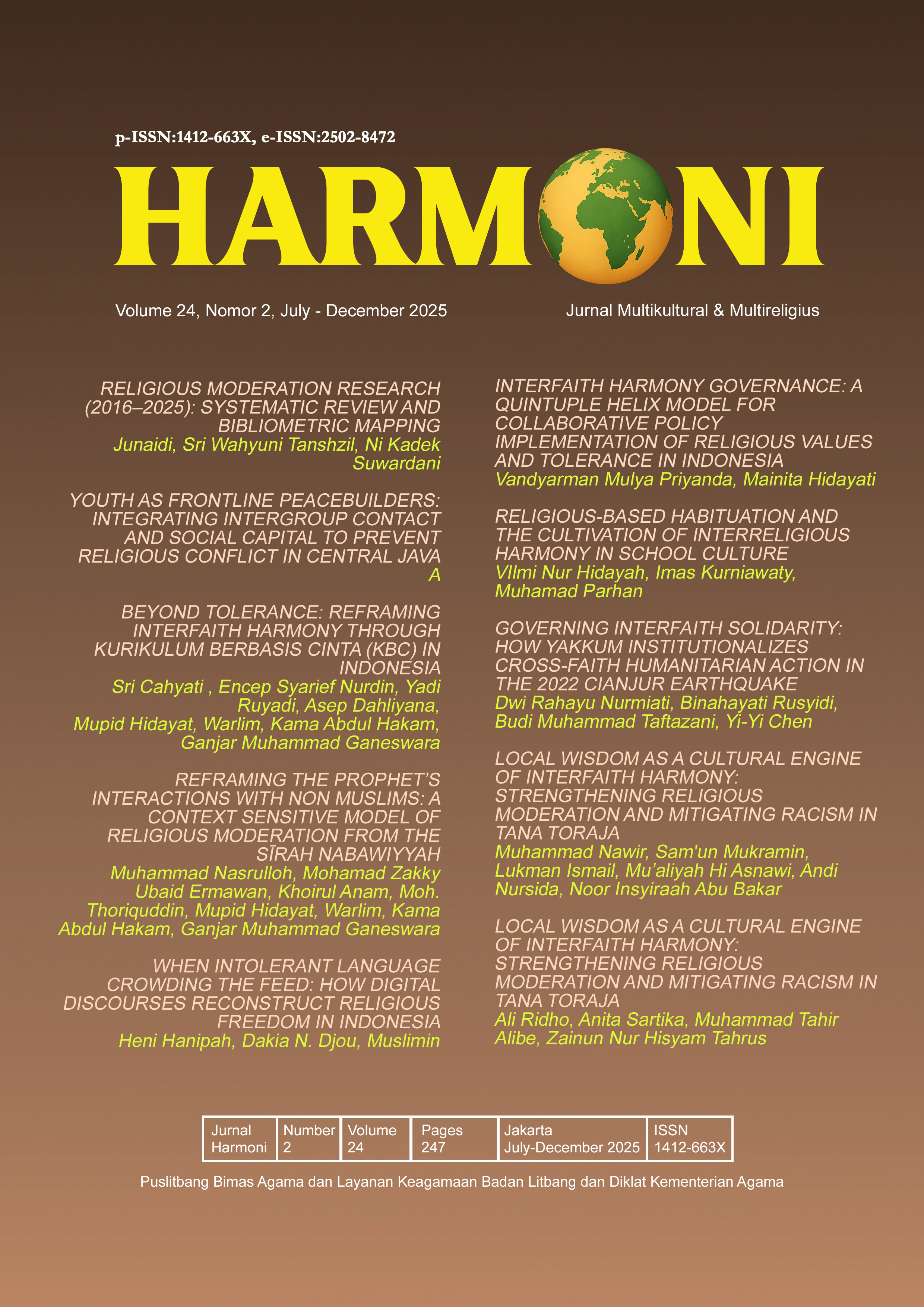
RELIGIOUS MODERATION RESEARCH (2016–2025): SYSTEMATIC REVIEW AND BIBLIOMETRIC MAPPING
DOI:
https://doi.org/10.32488/harmoni.v24i2.888Keywords:
Religious Moderation, Tolerance, Pluralism, Civic Education, Systematic literature review, Islamic education, Interfaith HarmonyAbstract
Religious moderation has gained increasing scholarly attention as societies confront rising polarization, yet existing research remains fragmented between normative discourse and policy-driven interpretations. Few studies systematically map how the field has evolved conceptually and how it intersects with interfaith harmony at a global level. This study addresses this gap by conducting a Systematic Literature Review using the PRISMA protocol combined with bibliometric analysis to examine Scopus-indexed publications on religious moderation from 2016 to 2025. The dataset consists of 235 peer-reviewed journal articles, and the analysis integrates descriptive statistics, thematic coding, and VOSviewer-based mapping of co-authorship and keyword networks. The findings show a rapid expansion of research after 2020, with Indonesia emerging as the dominant contributor and education-related contexts becoming the most frequently explored domain. Bibliometric mapping identifies three major thematic clusters: religious moderation in educational and civic settings, local wisdom and cultural practices, and digital-era challenges related to radicalism and polarization. Conceptually, the field is shifting from state-centered narratives toward relational ethics that emphasize interfaith coexistence. These results highlight the need for broader cross-regional collaboration and more comparative, theory-driven studies that move beyond national policy frameworks. The study concludes that religious moderation is evolving into a multidisciplinary lens for understanding interfaith relations and recommends future research focusing on leadership, digital citizenship, and community-based interfaith engagement.
Abstrak
Moderasi beragama semakin mendapat perhatian akademik seiring meningkatnya polarisasi sosial, namun penelitian yang ada masih terfragmentasi antara wacana normatif dan interpretasi berbasis kebijakan. Hanya sedikit studi yang secara sistematis memetakan perkembangan konseptual bidang ini serta keterkaitannya dengan harmoni antaragama pada tingkat global. Penelitian ini mengisi kesenjangan tersebut dengan melakukan Tinjauan Literatur Sistematis menggunakan protokol PRISMA yang dipadukan dengan analisis bibliometrik terhadap publikasi terindeks Scopus mengenai moderasi beragama pada periode 2016 hingga 2025. Dataset terdiri dari 235 artikel jurnal terbitan sejawat, dan analisis dilakukan melalui statistik deskriptif, pengodean tematik, serta pemetaan jejaring penulis dan kata kunci menggunakan VOSviewer. Temuan menunjukkan peningkatan pesat penelitian setelah tahun 2020, dengan Indonesia sebagai kontributor dominan dan konteks pendidikan sebagai domain yang paling sering dikaji. Pemetaan bibliometrik mengidentifikasi tiga klaster tematik utama yaitu moderasi beragama dalam konteks pendidikan dan kewargaan, kearifan lokal dan praktik budaya, serta tantangan era digital terkait radikalisme dan polarisasi. Secara konseptual, bidang ini bergerak dari narasi berpusat pada negara menuju etika relasional yang menekankan koeksistensi antaragama. Hasil ini menegaskan perlunya kolaborasi lintas kawasan dan penelitian komparatif yang lebih berorientasi teori di luar kerangka kebijakan nasional. Studi ini menyimpulkan bahwa moderasi beragama berkembang menjadi lensa multidisipliner untuk memahami relasi antaragama dan merekomendasikan penelitian lanjutan mengenai kepemimpinan, kewargaan digital, dan keterlibatan antaragama berbasis komunitas.
Downloads
References
Ali Gilani, S. I., Khaliq, A., & Waheed, A. (2024). Inter-Civilizational Issues And The Factors Affecting Interfaith Relationships: A Study Of Muhammad Hamidullah’s Contributions. Al-Shajarah, 2024(Special Issue), 263–293. https://doi.org/10.31436/shajarah.vi.1938
Amri, Y., Febriandi, Y., & Da-Oh, P. (2024). RELIGIOUS MODERATION UNVEILED: The Intersection of Textual and Contextual Approaches to Understanding Indonesian Muslims. Miqot: Jurnal Ilmu-Ilmu Keislaman, 48(1), 105–125. https://doi.org/10.30821/miqot.v48i1.1207
Anggaira, A. S., Madkur, A., Setiyana, L., Sari, Y. A., & Aryanti, N. (2025). Development of Hybrid English Learning Materials Integrated with the Values of Religious Moderation. Forum for Linguistic Studies, 7(7), 980–991. https://doi.org/10.30564/fls.v7i7.9440
Athoillah, M., Rahman, A. S., Firdaus, A. S., & Septiadi, M. A. (2024). Policies And Practices Religious Moderation In Pesantren. Jurnal Pendidikan Islam, 10(2), 387–396. https://doi.org/10.15575/jpi.v10i2.27543
Azizah, N., Nurdianzah, E., Wijaya, M. M., Azami, T., & Rohman, A. (2023). Religious Moderation in The Industrial Era 4.0: Deradicalization Through The Development of Intellectual Traditions at Fadhlul Fadhlan Islamic Boarding School Semarang. Jurnal Pendidikan Agama Islam, 20(2), 233–246. https://doi.org/10.14421/jpai.v20i2.7771
Bahri, R., Rofiqi, M., & Rusydiyah, E. F. (2025). Religious moderation education: a comparative study of Islamic approaches in Indonesia and Malaysia with implications for faith-based education. International Studies in Catholic Education. https://doi.org/10.1080/19422539.2025.2519727
Benawa, A., & Wardhani, R. (2024). The Significance Contribution of Lecturer Competence in Delivering Project Base Learning on The Student Religious Moderation through Religion Education. Proceedings of International Conference on Research in Education and Science, 10(1), 651–662. https://www.scopus.com/inward/record.uri?eid=2-s2.0-85217688783&partnerID=40&md5=6592560497b19fdd1943c57fa618febb
Camilo, C., & Vaz Garrido, M. (2019). Systematic review in psychology: Challenges and guidelines. Analise Psicologica, 37(4), 535–552. https://doi.org/10.14417/ap.1546
Casidy, R., Duhachek, A., Singh, V., & Tamaddoni, A. (2021). Religious Belief, Religious Priming, and Negative Word of Mouth. Journal of Marketing Research, 58(4), 762–781. https://doi.org/10.1177/00222437211011196
Cholil, S. (2022). First Essay Freedom of Religion amid Polarization and Religious Moderation Policy. Interreligious Studies and Intercultural Theology, 6(2), 196–204. https://doi.org/10.1558/isit.24603
Chotimah, C., Qudsy, S. Z., & Yusuf, M. (2025). Superficial implementation of religious moderation in Islamic educational management. Cogent Education, 12(1). https://doi.org/10.1080/2331186X.2024.2442235
Chotisarn, N., & Phuthong, T. (2025). Place branding as a soft power tool: A systematic review, bibliometric analysis, and future research directions. International Review of Management and Marketing, 15(4), 123.
Daffa, M. (2023). The relevance of the Abu Dhabi document as a sustainability of religious moderation in Indonesia from a hadith perspective. Harmoni, 22(2), 248–266.
Dewi, K. A. P., Perbowosari, H., & Wahyuni, N. N. T. (2025). The “Care” learning model: The value education for strengthening the religious moderation. Edelweiss Applied Science and Technology, 9(4), 468–479. https://doi.org/10.55214/25768484.v9i4.6019
Fadil, n., Marwinata, P., Jannah, S., & Siroj, A. M. (2024). Religious Moderation and Family Resilience in the City of Malang, Indonesia: The Historical Perspectives of the Islamic Law. Samarah, 8(1), 236–256. https://doi.org/10.22373/sjhk.v8i1.19821
Furqan, M., & Ab. Nasir, A. F. A. (2024). Big Data Approach To Sentiment Analysis In Machine Learning-Based Microblogs: Perspectives Of Religious Moderation Public Policy In Indonesia. Journal of Applied Engineering and Technological Science, 5(2), 955–965. https://doi.org/10.37385/jaets.v5i2.4498
Ghosh, R. (2025). RELIGION, EDUCATION, AND EXTREMISM. In The Oxford Handbook of Religion and Education (pp. 651–669). https://doi.org/10.1093/oxfordhb/9780198869511.013.41
Gunawan, E., Tohis, R. A., & Hakim, B. R. (2023). Implications of the Law of Religious Moderation on Interfaith Marriages. Jurnal Ilmiah Al-Syir’ah, 21(2), 283–296. https://doi.org/10.30984/jis.v21i2.2649
Gutkowski, S. (2016). We are the very model of a moderate Muslim state: The Amman Messages and Jordan’s foreign policy. International Relations, 30(2), 206–226. https://doi.org/10.1177/0047117815598352
Hamzah, n. (2022). The Reflection Of Medina Charter As A Basis For Religious Moderation In Indonesia. 5(1), 1–17. https://doi.org/10.30863/jad.v5i1.2601
Hanif, M., Maruti, E. S., Anwar, R. N., & Sukarti, S. (2025). Cultivating religious moderation in the life of the Buddhist community of Sodong Village (Indonesia): an ethnographic study. Cogent Arts and Humanities, 12(1). https://doi.org/10.1080/23311983.2025.2506318
Hasan, K., & Juhannis, H. (2024). Religious education and moderation: A bibliometric analysis. Cogent Education, 11(1). https://doi.org/10.1080/2331186X.2023.2292885
Hayat, T. J., Anshori, M., Abas, A., & Arsyada, A. Z. (2025). Sufi Ethics And Religious Moderation Through A Revisit Of Miftāḥ Al-Ṣudūr For Contemporary Social Harmony. Jurnal Lektur Keagamaan, 23(1), 211–244. https://doi.org/10.31291/jlka.v23i1.1311
Husain, S., & Dwi Wahyuni, A. E. (2021). Moderasi Beragama Berbasis Tradisi Pesantren Pada Maγçöhad Aly Asγçöadiyah Sengkang Wajo Sulawesi Selatan. Harmoni, 20(1 SE-Articles), 48–66. https://doi.org/10.32488/harmoni.v20i1.455
Ince, B. (2012). Citizenship education in Turkey: Inclusive or exclusive. Oxford Review of Education, 38(2), 115–131. https://doi.org/10.1080/03054985.2011.651314
Irawan, & Nasrun. (2025). The significance of religious moderation between islam and chinese in Bangka Island in fostering and maintaining the unitary state of the Republic of Indonesia. Multidisciplinary Science Journal, 7(7). https://doi.org/10.31893/multiscience.2025335
Ismail, A. M., Jamir Singh, P. S., & Mujani, W. K. (2025). A systematic review: unveiling the complexity of definitions in extremism and religious extremism. Humanities and Social Sciences Communications, 12(1). https://doi.org/10.1057/s41599-025-05685-z
Iswanto, A., & Saefullah, A. (2021). Narasi Moderasi Beragama dalam Naskah Serat Carub Kandha. Jurnal Lektur Keagamaan, 19(1), 37–68.
Itmam, M. S., & Aouich, A. (2024). Legal Politics Of Religious Moderation And State Defense Policy At Public Universities. Justicia Islamica, 21(1), 87–110. https://doi.org/10.21154/justicia.v21i1.9242
Junaidi, Tanshzil, S. W., & Komalasari, K. (2025). Tracking the evolution of citizenship and religious education studies: a bibliometric analysis (2015–2025). British Journal of Religious Education, 1–18.
Liem, J., Kadi, S., & Neonbasu, G. (2024). Human Right Violation Through State Terrorism in Indonesia. International Journal on Minority and Group Rights, 31(5), 874–897. https://doi.org/10.1163/15718115-bja10149
Liu, Y., Rakthin, C., & Budianto, L. (2025). Religious Moderation and Community Cohesion: Exploring Social Memory, Identity, and Solidarity in the Phu Khao Thong Muslim Community, Ayutthaya. Millah: Journal of Religious Studies, 24(1), 379–392. https://doi.org/10.20885/millah.vol24.iss1.art10
Ma’arif, S., Ibda, H., Ahmadi, F., Qosim, N., & Muanayah, N. A. (2023). Islamic moderation in education and the phenomenon of cyberterrorism: a systematic literature review. Indonesian Journal of Electrical Engineering and Computer Science, 31(3), 1523–1533. https://doi.org/10.11591/ijeecs.v31.i3.pp1523-1533
Ma, R., You, Y., Gui, X., & Kou, Y. (2023). How Do Users Experience Moderation?: A Systematic Literature Review. Proceedings of the ACM on Human-Computer Interaction, 7(CSCW2). https://doi.org/10.1145/3610069
Mahmud, M. E., & Umiarso, U. (2025). School Leadership Models and Efforts Reconstruction of Religious Moderation in State Madrasah Aliyah in Indonesia. Educational Process: International Journal, 14. https://doi.org/10.22521/edupij.2025.14.18
Mahmudah, S., Alamsyah, A., Firdawaty, L., Yuliatin, Y., Yanti, I., & Asnawi, H. S. (2025). Resistance To Religious Moderation In Indonesian’s Lower To Middle-Class Communities. Jurnal Ilmiah Peuradeun, 13(2), 931–958. https://doi.org/10.26811/peuradeun.v13i2.2011
Marpaung, W., Azizah, N., & Siregar, P. A. (2024). Islamic education, depression, religiosity, and the effects of religion moderation of Muslim students. HTS Teologiese Studies / Theological Studies, 80(1). https://doi.org/10.4102/hts.v80i1.9271
Marzi, G., Balzano, M., Caputo, A., & Pellegrini, M. M. (2025). Guidelines for bibliometric‐systematic literature reviews: 10 steps to combine analysis, synthesis and theory development. International Journal of Management Reviews, 27(1), 81–103.
Moreau, E. (2025). Interfaith Dialogue And Its Role In Modern Pluralistic Societies: A Philosophical Examination. European Journal for Philosophy of Religion, 17(2), 175–191. https://doi.org/10.24204/ejpr.2025.4784
Muhsin, M., Kususiyanah, A., & Maksum, M. (2024). Religious Moderation in Indonesian Islamic Universities: Policy Implementation and Identity Formation at IAIN Ponorogo. Ascarya: Journal of Islamic Science, Culture and Social Studies, 4(2), 54–66. https://doi.org/10.53754/iscs.v4i2.713
Muhtar, M. Z. (2021). Moderasi Beragama dalam Kitab Tasawuf Al-MuntakhabÄ t karya KH. Ahmad Asrori Al-Ishaqi. Jurnal Lektur Keagamaan, 19(1), 269–306.
Muliadi, M., Syamsidar, S., & Islam, N. (2025). Religious Moderation By Design: A Comparative Sociological Da’wah Study In Indonesian Higher Education. Jurnal Ilmiah Peuradeun, 13(2), 1549–1580. https://doi.org/10.26811/peuradeun.v13i2.1778
Nanuru, R. F., Ruhulessin, J. C., & Ruimassa, A. A. (2025). A contextual model of religious moderation in the ‘Orang Basudara’ Church: Insights from the Protestant Church of Maluku (GPM). HTS Teologiese Studies / Theological Studies, 81(1). https://doi.org/10.4102/hts.v81i1.10467
Nasir, M., & Rijal, M. K. (2021). Keeping the middle path: mainstreaming religious moderation through Islamic higher education institutions in Indonesia. Indonesian Journal of Islam and Muslim Societies, 11(2), 213–241. https://doi.org/10.18326/ijims.v11i2.213-241
Ni, C., & Abdullah, N. L. (2025). Research on absorptive capacity in the green context: a bibliometric and visualization analysis. Cogent Business & Management, 12(1), 2435602.
Nurhayati, L., Supriadi, U., Jenuri, J., & Karim, A. (2025). Integrating digital citizenship and religious moderation in open and distance education: a holistic approach to character development in Indonesia. Asian Association of Open Universities Journal. https://doi.org/10.1108/AAOUJ-02-2025-0025
Pajarianto, H., Pribadi, I., & Galugu, N. S. (2023). Youth religious moderation model and tolerance strengthening through intellectual humility. HTS Teologiese Studies / Theological Studies, 79(1). https://doi.org/10.4102/hts.v79i1.8196
Pratidinal Jadid, R. (2021). Religious Moderation in Walisongo Material in History Textbook of Islamic Culture Class VI Madrasah Ibtidaiyah Ministry of Religion 2016. Jurnal Pendidikan Agama Islam, 18(1), 55–88. https://doi.org/10.14421/jpai.2021.181-04
Putri, N. (2023). Religious Harmony Forum (Fkub) Strategy In Increasing Religious Moderation Jurisprudence In Bengkulu Province. Jurnal Ilmiah Mizani, 10(1), 171–185. https://doi.org/10.29300/mzn.v10i1.2952
Qomusuddin, I. F., Latifah, S., & Erihadiana, M. (2025). Determinants Of Students’religious Moderation In Indonesian Islamic Higher Education: A CONFIRMATORY FACTOR ANALYSIS APPROACH. Harmoni, 24(1), 128–148.
Qoumas, Y. C., Hussain, R. B. B. M., & Rahim, R. A. B. A. (2024). The Dissemination Of Religious Moderation Through The Policy Of The Indonesian Ministry Of Religious Affairs. Qudus International Journal of Islamic Studies, 12(1), 147–176. https://doi.org/10.21043/qijis.v12i1.27552
Rasyid, A., Muvid, M. B., Lubis, M. A., & Kurniawan, P. (2022). The Actualization of the Concept of National Fiqh in Building Religious Moderation in Indonesia. Millah: Journal of Religious Studies, 21(2), 433–464. https://doi.org/10.20885/millah.vol21.iss2.art5
Rieffer-Flanagan, B. A. (2025). Diplomatic Initiatives for the Classroom: Why Teaching Children to Respect Freedom of Religion or Belief Is Important in Foreign Policy. Religion and Human Rights, 20(2), 85–113. https://doi.org/10.1163/18710328-bja10051
Rofik, A., Setyosari, P., & Effendi, M. (2022). The Effect of Collaborative Problem Solving & Collaborative Project-Based Learning Models to Improve the Project Competences of Pre-Service Teachers. Pegem Journal of Education and Instruction, 12(3), 130–143.
Roqib, M., Humaidi, M. W., Niswah, E. M., Zain, M. F., & Mulyani, S. (2025). Cultural Harmonization through Islamic Education: between Religious Moderation in Javanese Traditions in Penginyongan. Journal of Ecohumanism, 4(1), 1848–1858. https://doi.org/10.62754/joe.v4i1.6000
Rusmana, D., Gunawan, H., & Martiningsih, D. (2025). Instilling Moderation: Transforming Religious Education In Madrasah Aliyah. Jurnal Ilmiah Peuradeun, 13(1), 77–102. https://doi.org/10.26811/peuradeun.v13i1.1830
Saebani, B. A., & Rahman, M. T. (2025). From Outsider to Engagement: The Transformation of a Puritanical Islamic Organization through Government-Led Religious Moderation Initiatives. Journal of Islamic Thought and Civilization, 15(1), 277–295. https://doi.org/10.32350/jitc.151.16
Schwadel, P. (2015). Explaining Cross-National Variation in the Effect of Higher Education on Religiosity. Journal for the Scientific Study of Religion, 54(2), 402–418. https://doi.org/10.1111/jssr.12187
Schweizer, M. L., & Nair, R. (2017). A practical guide to systematic literature reviews and meta-analyses in infection prevention: Planning, challenges, and execution. American Journal of Infection Control, 45(11), 1292–1294. https://doi.org/10.1016/j.ajic.2017.08.004
Shrivastava, P., & Mishra, R. (2025). Systematic Reviews in Epidemiological Studies. In Epidemiology and Environmental Hygiene in Veterinary Public Health (pp. 229–244). https://doi.org/10.1002/9781394208180.ch18
Sihombing, A. A., & Maigahoaku, F. D. (2025). Constructing moderate attitude through religious education. Cakrawala Pendidikan, 44(2), 337–345. https://doi.org/10.21831/cp.v44i2.78726
Singgih, E. G. (2023). Religious Moderation as Good Life: Two Responses to the Ministry of Religious Affairs’ Directive on Religious Moderation in Indonesia. Exchange, 52(3), 220–240. https://doi.org/10.1163/1572543X-bja10038
Suhendi, S., Sawahel, W. A.-F., & Abdillah, K. Y. (2020). Preventing Radicalism Through Integrative Curriculum At Higher Education. Jurnal Pendidikan Islam, 6(1), 79–94. https://doi.org/10.15575/jpi.v6i1.8498
Suleman, Z. Z., Tungkagi, D. Q., Suleman, Z., Kau, S. A. P., & Salleh, M. A. (2025). Negotiating Islamic Moderation: The Interplay of Sharia and Local Culture in Gorontalo, Minangkabau, and Banten. Jurnal Ilmiah Al-Syir’ah, 23(1), 50–69. https://doi.org/10.30984/jis.v23i1.3527
Suyuti Yusuf, M., Pajarianto, H., & Sulaiman, B. (2025). A collaborative parent-teacher model for religious moderation education in early childhood in Indonesia. South African Journal of Childhood Education, 15(1). https://doi.org/10.4102/sajce.v15i1.1593
Syarifin, A., & Lestari, M. (2025). Educational Technology to Facilitate Access to Local Wisdom Practices in Religious Moderation. International Research Journal of Multidisciplinary Scope, 6(3), 349–357. https://doi.org/10.47857/irjms.2025.v06i03.05129
Takdir, M. (2025). Moderation reasoning based on religious literacy to prevent radicalisation among interfaith Generation Z in Indonesia. International Studies in Catholic Education. https://doi.org/10.1080/19422539.2025.2568712
Tausch, A. (2021). Executive Summary, Conclusions, and Perspectives. In Gulf Studies (Vol. 2, pp. 371–391). https://doi.org/10.1007/978-3-030-78299-3_9
Tiara, M., Ananda, A., & Montessori, M. (2025). Civic Education and the Existence of Ethnic Identity of Descent. Educational Process: International Journal, 16. https://doi.org/10.22521/edupij.2025.16.257
Tinambunan, E. R. L., Gegel, I. K., Sarbini, P. B., & Baik, G. Z. (2025). Implication Abu Dhabi Document: to build religious moderation with brotherhood-sisterhood and friendship in Indonesia. Cogent Arts and Humanities, 12(1). https://doi.org/10.1080/23311983.2025.2451514
Ubaidillah, U., & Faiz, M. F. (2025). Beyond The Sacred Walls: Reimagining Pesantren’s Architecture of Islamic Moderation. Ulumuna, 29(1), 32–70. https://doi.org/10.20414/ujis.v29i1.1362
Untung, N., Cahyono, H., Marbun, P., Hosea, A., Sumual, I. S., & Rajagukguk, J. S. P. (2025). Church planting strategies in the context of religious moderation in multicultural societies. HTS Teologiese Studies / Theological Studies, 81(1). https://doi.org/10.4102/hts.v81i1.10498
Višić, M. (2022). Connecting Puzzle Pieces: Systematic Literature Review Method In The Social Sciences. Sociologija, 64(4), 543. https://doi.org/10.2298/SOC2204543V
Yusuf, M., Putra, E., Witro, D., & Nurjaman, A. (2023). The Role Of Anak Jalanan At-Tamur Islamic Boarding School In Internalizing The Values Of Religious Moderation To College Students In Bandung. Jurnal Ilmiah Islam Futura, 23(2), 132–156. https://doi.org/10.22373/jiif.v23i1.15358
Zaluchu, S. E., Widodo, P., & Kriswanto, A. (2025). Conceptual reconstruction of religious moderation in the Indonesian context based on previous research: Bibliometric analysis. Social Sciences and Humanities Open, 11. https://doi.org/10.1016/j.ssaho.2025.101552
Zaman, M. B., Mawardi, I., & Muna, M. Y. (2024). Local Wisdom For Peacebuilding In Java: An Analysis Of Religious Moderation In Shodiq Hamzah’s Tafsīr Al-Bayān. Jurnal Lektur Keagamaan, 22(2), 455–482. https://doi.org/10.31291/jlka.v22i2.1295
Zamroni, E., Handayani, P. G., Gudnanto, G., Lestari, I., Azis, A. R., & Kumara, A. R. (2025). Mapping Religious Moderation and Its Impact on Islamic Education in Indonesia: A Bibliometric Approach. Munaddhomah, 6(1), 55–81. https://doi.org/10.31538/MUNADDHOMAH.V6I1.1487
Zhu, G. (2025). Religious Ethics And Global Governance: Theological Perspectives On International Cooperation And Conflict Resolution. European Journal for Philosophy of Religion, 17(2), 456–470. https://doi.org/10.24204/ejpr.2025.4728
Zulkifli, Z., Kafid, N., Nanang, H., & Fahri, M. (2023). The Construction Of Religious Moderation Among Indonesian Muslim Academics. Teosofi: Jurnal Tasawuf Dan Pemikiran Islam, 13(2), 337–366. https://doi.org/10.15642/teosofi.2023.13.2.337-366
Downloads
Published
Issue
Section
License
Copyright (c) 2025 Junaidi Junaidi, Sri Wahyuni Tanshzil

This work is licensed under a Creative Commons Attribution-NonCommercial-ShareAlike 4.0 International License.