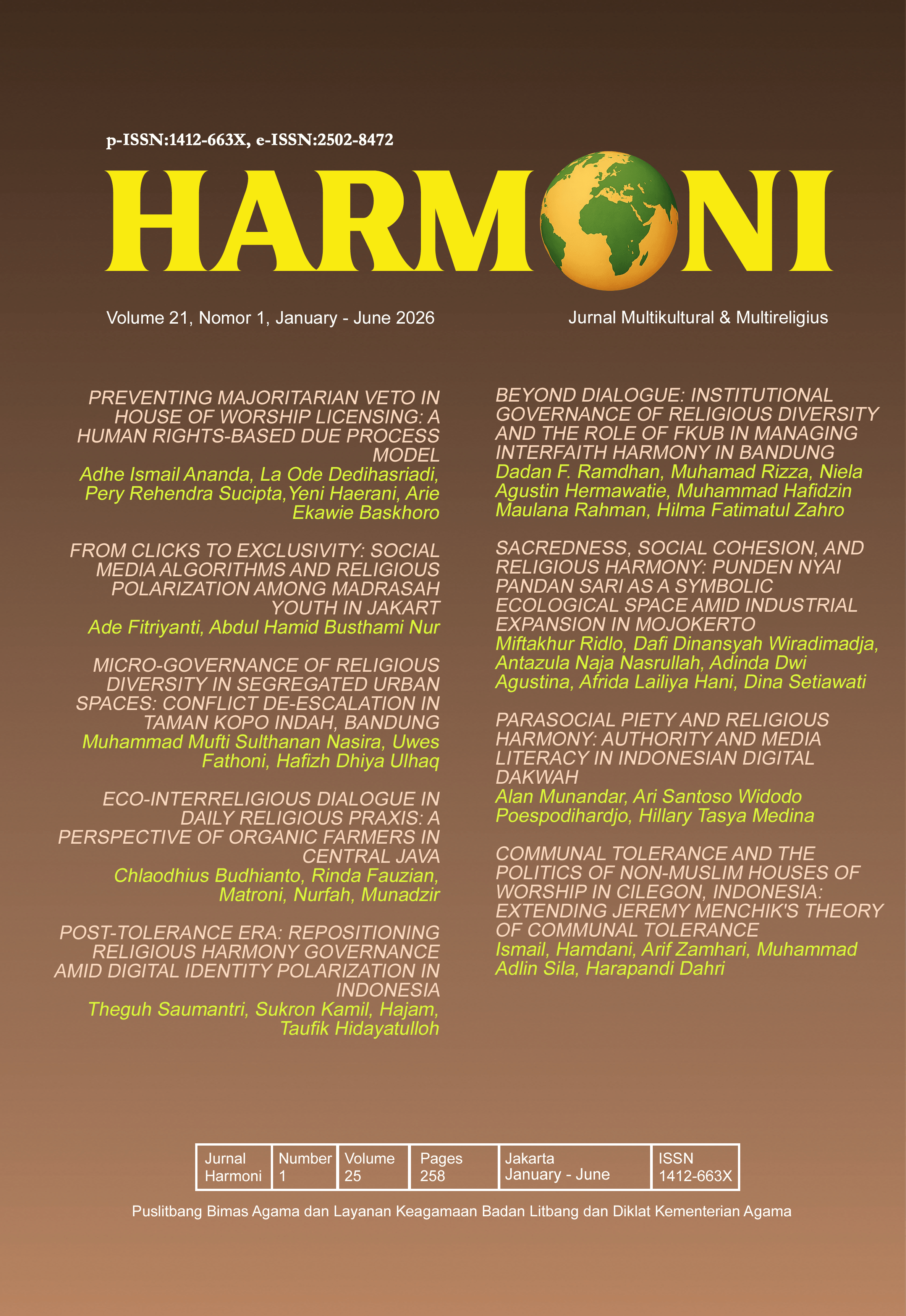
BEYOND DIALOGUE: INSTITUTIONAL GOVERNANCE OF RELIGIOUS DIVERSITY AND THE ROLE OF FKUB IN MANAGING INTERFAITH HARMONY IN BANDUNG
DOI:
https://doi.org/10.32488/harmoni.v25i1.1076Keywords:
Islamic Education, Religious Organizations, Teacher Income, Teacher Motivation, Teacher WelfareAbstract
Religious diversity in pluralistic urban societies presents significant governance challenges, requiring institutional mechanisms to sustain interfaith harmony and prevent social conflict. Although previous studies have examined interfaith dialogue and religious moderation, limited attention has been paid to how collaborative institutional governance manages religious diversity at the local level and to the empirical mechanisms by which local intermediary bodies translate normative tolerance into operational conflict prevention. This study aims to analyze the role of the Religious Harmony Forum (FKUB) within the institutional governance framework for maintaining interfaith harmony in Bandung, Indonesia. Employing a qualitative case study design, data were collected through semi-structured interviews with the Chairman of FKUB Bandung, the Acting Head of the Bandung City National Unity and Politics Agency (Kesbangpol), and the Head of the National Vigilance and Conflict Management Division, complemented by documentary analysis of official reports and conflict monitoring records. The data were analyzed using thematic analysis involving data reduction, coding, categorization, and interpretation. The findings reveal that religious harmony in Bandung is sustained through collaborative governance involving FKUB, Kesbangpol, religious organizations, community leaders, and local government agencies. FKUB functions not only as an interfaith dialogue forum but also as an institutional mediator facilitating communication, coordination, and conflict prevention. Most social tensions originate from socio-economic, socio-cultural, organizational, and political dynamics rather than theological differences. Building on these findings, the study conceptualizes religious harmony as an outcome of institutionalized social cohesion produced through collaborative governance, rather than as a passive absence of conflict. The study concludes that integrating institutional mediation, religious moderation, and cross-sector collaboration is essential for strengthening social resilience and sustaining long-term interfaith harmony in plural urban societies. Because the analysis draws on a single city and on institutional informants, the findings are presented as a transferable governance model rather than as a generalizable claim.
Abstrak
Keragaman agama dalam masyarakat perkotaan pluralistik menghadirkan tantangan tata kelola yang signifikan, membutuhkan mekanisme kelembagaan yang mempertahankan harmoni antaragama sekaligus mencegah konflik sosial. Meskipun penelitian sebelumnya telah meneliti dialog antaragama dan moderasi agama, perhatian terbatas telah diberikan pada bagaimana tata kelola kelembagaan kolaboratif mengelola keragaman agama di tingkat lokal, dan pada mekanisme empiris di mana badan perantara lokal mengubah toleransi normatif menjadi pencegahan konflik operasional. Penelitian ini bertujuan untuk menganalisis peran Forum Kerukunan Beragama (FKUB) dalam kerangka tata kelola kelembagaan untuk menjaga kerukunan antaragama di Bandung, Indonesia. Dengan menggunakan desain studi kasus kualitatif, data dikumpulkan melalui wawancara semi-terstruktur dengan Ketua FKUB Bandung, Plt. Kepala Badan Persatuan Nasional dan Politik (Kesbangpol) Kota Bandung, dan Kepala Divisi Kewaspadaan dan Penanggulangan Konflik Nasional, dilengkapi dengan analisis dokumenter laporan resmi dan catatan pemantauan konflik. Data dianalisis menggunakan analisis tematik yang melibatkan reduksi data, pengkodean, kategorisasi, dan interpretasi. Temuan tersebut mengungkapkan bahwa kerukunan beragama di Bandung dipertahankan melalui tata kelola kolaboratif yang melibatkan FKUB, Kesbangpol, organisasi keagamaan, tokoh masyarakat, serta instansi pemerintah daerah. FKUB berfungsi tidak hanya sebagai forum dialog antaragama tetapi juga sebagai mediator kelembagaan yang memfasilitasi komunikasi, koordinasi, dan pencegahan konflik. Sebagian besar ketegangan sosial berasal dari dinamika sosial-ekonomi, sosial-budaya, organisasi, dan politik daripada perbedaan teologis. Berdasarkan temuan ini, studi ini mengkonseptualisasikan kerukunan beragama sebagai hasil dari kohesi sosial yang dilembagakan yang dihasilkan melalui tata kelola kolaboratif, bukan sebagai ketiadaan konflik secara pasif. Studi ini menyimpulkan bahwa mengintegrasikan mediasi kelembagaan, moderasi agama, dan kolaborasi lintas sektor sangat penting untuk memperkuat ketahanan sosial serta mempertahankan harmoni antaragama jangka panjang dalam masyarakat perkotaan yang plural. Karena analisis ini mengacu pada satu kota dan satu informan institusional, temuan ini disajikan sebagai model tata kelola yang dapat ditransfer, bukan sebagai klaim yang dapat digeneralisasi.
Downloads
References
Ahmed, S., Mohammed, R., Nashwan, A., Ibrahim, R., Abdalla, A., Amin, B., & Khdhir, R. (2025). Using thematic analysis in qualitative research. SSRN Electronic Journal. https://doi.org/10.2139/ssrn.5222482
Anas, M., Saraswati, D., Ikhsan, M., & Fiaji, N. (2025). Acceptance of 'The Others' in Religious Tolerance: Policies and Implementation Strategies in The Inclusive City of Salatiga Indonesia. Heliyon, 11, e41826. https://doi.org/10.1016/j.heliyon.2025.e41826
Ansell, C., & Gash, A. (2008). Collaborative Governance in Theory and Practice. Journal of Public Administration Research and Theory, 18(4), 543-571. https://doi.org/10.1093/jopart/mum032
Ansyar, Sukri, Abdullah, S., & Ibrahim, M. (2025). Interactive Governance and Actor Diversity in Religious Conflict Prevention: A Case Study of Makassar City, Indonesia. KnE Social Sciences, 10, 1583-1600. https://doi.org/10.18502/kss.v10i18.19585
Ardiansyah, A. (2012). Peran Forum Kerukunan Umat Beragama (FKUB) dalam Menangani Konflik Pendirian Rumah Ibadah. TOLERANSI: Media Ilmiah Komunikasi Umat Beragama, 4(1), 1-25. https://doi.org/10.24014/trs.v4i1.1029
Arianto, B. (2024). Triangulasi Metoda Penelitian Kualitatif (Vol. 1). Borneo Novelty Publishing. https://doi.org/10.70310/q81zdh33
Aslati, A. (2014). Optimalisasi Peran Fkub dalam Menciptakan Toleransi Beragama di Kota Pekanbaru. Toleransi, 6(2), 188-199. https://doi.org/10.24014/trs.v6i2.906
Asnawati, A. (2012). Peranan Forum Kerukunan Umat Beragama (FKUB): Studi Kasus Pelaksanaan PBM No.9 dan No.8 Tahun 2006 di Jakarta Utara. Harmoni, 11(1), 129-137. https://doi.org/10.32488/harmoni.v11i1.236
Braun, V., & Clarke, V. (2013). Successful Qualitative Research: A Practical Guide for Beginners (Vol. 2). SAGE Publications Ltd.
Carter, N., Bryant-Lukosius, D., Dicenso, A., Blythe, J., & Neville, A. (2014). The Use of Triangulation in Qualitative Research. Oncology Nursing Forum, 41, 545-547. https://doi.org/10.1188/14.ONF.545-547
Creswell, J. W., & Guetterman, T. C. (2019). Educational Research: Planning, Conducting, and Evaluating Quantitative and Qualitative Research. Pearson.
Creswell, J. W., & Poth, C. N. (2018). Qualitative Inquiry and Research Design: Choosing Among Five Approaches (4th ed.). SAGE.
Daheri, M., Warsah, I., Morganna, R., Putri, O. A., & Adelia, P. (2023). Strengthening Religious Moderation: Learning from the Harmony of Multireligious People in Indonesia. Journal of Population and Social Studies, 31, 571-586. https://doi.org/10.25133/JPSSv312023.032
Dewi, N. P. S., Idris, H., Fariq, A., Rudiana, R., & D, A. Z. (2025). The Role of Public Relations in Promoting Interfaith Dialogue. Journal International Dakwah and Communication, 5(1), 1-15. https://doi.org/10.55849/jidc.v4i2.764
Emerson, K., & Nabatchi, T. (2015). Collaborative Governance Regimes. Georgetown University Press.
Erawati, D., Djabarudin, M., & Nuranisa, V. (2026). Harmoni Beragama Melalui Pendidikan Multikultural dalam Studi Pendidikan Agama Islam di Indonesia-Singapura. Addabani: Interdisciplinary Journal of Islamic Education, 3(2), 114-131. https://doi.org/10.52593/adb.03.2.03
Faqih, A. (2021). The Role of Forum Kerukunan Umat Beragama (FKUB) for Religious Harmony and the Rights of Freedom of Religion or Belief (FoRB). Religio: Jurnal Studi Agama-Agama, 11, 75-93. https://doi.org/10.15642/religio.v11i1.1662
Harahap, R. A. G., & Faridah, F. (2024). Penerapan Fungsi Manajemen Forum Kerukunan Umat Beragama Dalam Membangun Kerukunan dan Moderasi Beragama di Kota Medan. Jurnal Manajemen Pendidikan Dan Ilmu Sosial, 5(3), 138-148. https://doi.org/10.38035/jmpis.v5i3.1872
Hidayat, A., & Sitompul, J. (2024). Upaya Forum Kerukunan Umat Beragama Tapanuli Selatan dalam Melestarikan Budaya Moderasi Beragama pada Masyarakat Tapanuli Selatan. Tadbir: Jurnal Manajemen Dakwah FDIK IAIN Padangsidimpuan, 6(2), 283-302. https://doi.org/10.24952/tadbir.v6i2.14671
Hudin, H., Amin, A., Fahmi, M. R., & Sulaiman, R. (2025). Moderasi Beragama dalam Forum Kerukunan Umat Beragama (FKUB) di Kalimantan Barat. Sujud: Jurnal Agama, Sosial Dan Budaya, 1(3), 342-352. https://doi.org/10.63822/2nzgvm42
Irastorza, N., Gomez-Sanchez, D., & Martinez-Arino, J. (2026). Governance of religious diversity: Current challenges and approaches to democratic coexistence. Deusto Journal of Human Rights, 11-33. https://doi.org/10.18543/djhr.3551
Japar, M., Situmorang, R., Hermanto, Muyaroah, S., Alfani, H., Ma'arif, M., & Fitriyani. (2025). Strengthening Political Tolerance through a Digital-Based Democratic Education Model at Baturaja University, Indonesia. Journal of Social Studies Education Research, 16(4), 380-413.
Jubba, H., Awang, J., Qodir, Z., Hannani, & Pabbajah, M. (2022). The contestation between conservative and moderate Muslims in promoting Islamic moderatism in Indonesia. Cogent Social Sciences, 8(1), 2116162. https://doi.org/10.1080/23311886.2022.2116162
Julius, A., Isaac Kazaara, A., & Hadiijah, N. (2026). Beyond the Dichotomy: The Imperative of Reconciling Kohlberg's Moral Development with Social Cohesion Theory. 5, 627-642.
Kamaliah, N., Fitriany, A., Mubarok, M., & Widodo, J. (2024). The History of FKUB in The Development of Character Education for Religious Communities in Sidoarjo. Entita: Jurnal Pendidikan Ilmu Pengetahuan Sosial Dan Ilmu-Ilmu Sosial, 6. https://doi.org/10.19105/ejpis.v6i2.14772
Koch, A. (2020). Cosmopolitan Modes of Governance of Religious Diversity across Europe. Interdisciplinary Journal for Religion and Transformation in Contemporary Society, 6, 533-549. https://doi.org/10.30965/23642807-00602015
Monia, N. G. (2023). The Role of Religions in Education of Ethics of Diversity. Unisia, 41(1), 77-102. https://doi.org/10.20885/unisia.vol41.iss1.art4
Nawir, M., Mukramin, S., Ismail, L., Asnawi, M. H., Nursida, A., & Bakar, N. I. A. (2025). Local Wisdom As A Cultural Engine of Interfaith Harmony: Strengthening Religious Moderation and Mitigating Racism in Tana Toraja. Harmoni, 24(2), 361-379. https://doi.org/10.32488/harmoni.v24i2.918
Neger S, W., Setiawibawa, R., Fahmi, S., & Uksan, A. (2025). Managing Differences: Multicultural Community Strategies to Prevent Conflict. International Journal Of Humanities Education and Social Sciences (IJHESS), 5(3). https://doi.org/10.55227/ijhess.v5i3.2012
Obiekezie, E. O., & Timothy, A. E. (2015). Fostering Ethnic and Religious Harmony through Classroom Language Experiences. Journal of Education and Practice, 6(25), 55-61.
Priyanda, V. M., & Hidayati, M. (2025). Interfaith Harmony Governance: A Quintuple Helix Model for Collaborative Policy Implementation of Religious Values and Tolerance in Indonesia. Harmoni, 24, 299-325. https://doi.org/10.32488/harmoni.v24i2.927
Rofiq, A. (2023). Komunikasi Forum Kerukunan Umat Beragama (FKUB) Sebagai Perwujudan Moderasi Beragama di Kabupaten Banyuwangi. Al-Tsiqoh: Jurnal Ekonomi Dan Dakwah Islam, 8(2), 50-78. https://doi.org/10.31538/altsiq.v8i2.4863
Rohmawati, W. S. A., Cholil, S., & Udasmoro, W. (2022). Nationality, Locality, and Religiosity: Works and Thoughts of Maria Theresia Geme of the Forum for Religious Harmony of East Nusa Tenggara. Religious: Jurnal Studi Agama-Agama Dan Lintas Budaya, 6(3), 317-330. https://doi.org/10.15575/rjsalb.v6i3.22151
Shobirin, M. S., & Zakki, M. (2025). Governance And Policy Frameworks For Promoting Religious Tolerance In Pluralistic Nations. MUNIF: International Journal of Religion Moderation, 1(1), 77-95. https://doi.org/10.71305/munif.v1i1.449
Stathi, S., Di Bernardo, G. A., Vezzali, L., Pendleton, S., & Tropp, L. (2020). Do they want contact with us? The role of intergroup contact meta-perceptions on positive contact and attitudes. Journal of Community & Applied Social Psychology, 30, 461-479. https://doi.org/10.1002/casp.2452
Suazo-Galdames, I. C., Saracostti, M., & Chaple-Gil, A. M. (2025). Scientific evidence and public policy: A systematic review of barriers and enablers for evidence-informed decision-making. Frontiers in Communication, 10. https://doi.org/10.3389/fcomm.2025.1632305
Subchi, I., Zulkifli, Z., Latifa, R., & Sa'diyah, S. (2022). Religious Moderation in Indonesian Muslims. Religions, 13(5), 451. https://doi.org/10.3390/rel13050451
Syukran, M., Bilondatu, A., Tabo, S., & Biongan, A. (2025). Peran FKUB Dalam Memfasilitasi, Memotivasi, dan Menggerakkan Moderasi Beragama. Jurnal MITRA, 23(1), 58-71.
Taopan, N. F., Ly, P., & Lobo, L. (2020). Peran Forum Kerukunan Umat Beragama dalam Meningkatkan Kualitas Sikap Hidup Toleransi Antar Umat Beragama di Kota Kupang. Jurnal Pendidikan PKN (Pancasila dan Kewarganegaraan), 1(1), 1-9. https://doi.org/10.26418/jppkn.v1i1.40086
Triyanto, Sutarti, T., Sari, D. I., & Hidayatulloh, M. M. (2025). Interfaith Dialogue in Schools: A Framework for Promoting Religious Tolerance among Students. International Society for Technology, Education, and Science. https://eric.ed.gov/?id=ED678971
Tuzzo, S., Braga, C., & Santos, I. (2023). The Metaphenomenon as a Genesis in the Triangulation Process of Qualitative Research in the Digital Age: The Reframing of the Object (pp. 121-132). https://doi.org/10.1007/978-3-031-31346-2_8
Wafir, A. (2025). Promoting Interfaith Tolerance Through Community-Based Initiatives: A Case Study of FKUB Salatiga. Unity Lens, 1(1), 20-25.
Wang, H., & Ran, B. (2023). Network governance and collaborative governance: A thematic analysis on their similarities, differences, and entanglements. Public Management Review, 25(6), 1187-1211. https://doi.org/10.1080/14719037.2021.2011389
Xinglong Qu, Kurokawa, S., & Han, T. A. (2023). Social cohesion, cooperation and tolerance.
Yang, H. (2025). Governance: Perspectives of public administration, health administration, and primary care. Chinese General Practice Journal, 2(1), 100045. https://doi.org/10.1016/j.cgpj.2025.100045
Zahra, F., & Sazali, H. (2024). Strengthening the Communication System of the Interfaith Harmony Forum (FKUB) in Serdang Berdagai. Jurnal Dakwah Dan Komunikasi, 9(2), 1-8. https://doi.org/10.29240/jdk.v9i2.11396
Zaluchu, S. E., Widodo, P., & Kriswanto, A. (2025). Conceptual reconstruction of religious moderation in the Indonesian context based on previous research: Bibliometric analysis. Social Sciences & Humanities Open, 11, 101552. https://doi.org/10.1016/j.ssaho.2025.101552
Zhou, W., Yin, B., Su, Y., & Hare, B. (2025). Tolerance as a key mechanism for large-scale social cohesion. Behavioral and Brain Sciences, 48. https://doi.org/10.1017/S0140525X25100435
Downloads
Published
Issue
Section
License
Copyright (c) 2026 Dadan F Ramdhan, Muhamad Rizza, Asri Sulastri, Niela Agustin Hermawatie, Muhammad Hafidzin Maulana Rahman, Hilma Fatimatul Zahro

This work is licensed under a Creative Commons Attribution-NonCommercial-ShareAlike 4.0 International License.