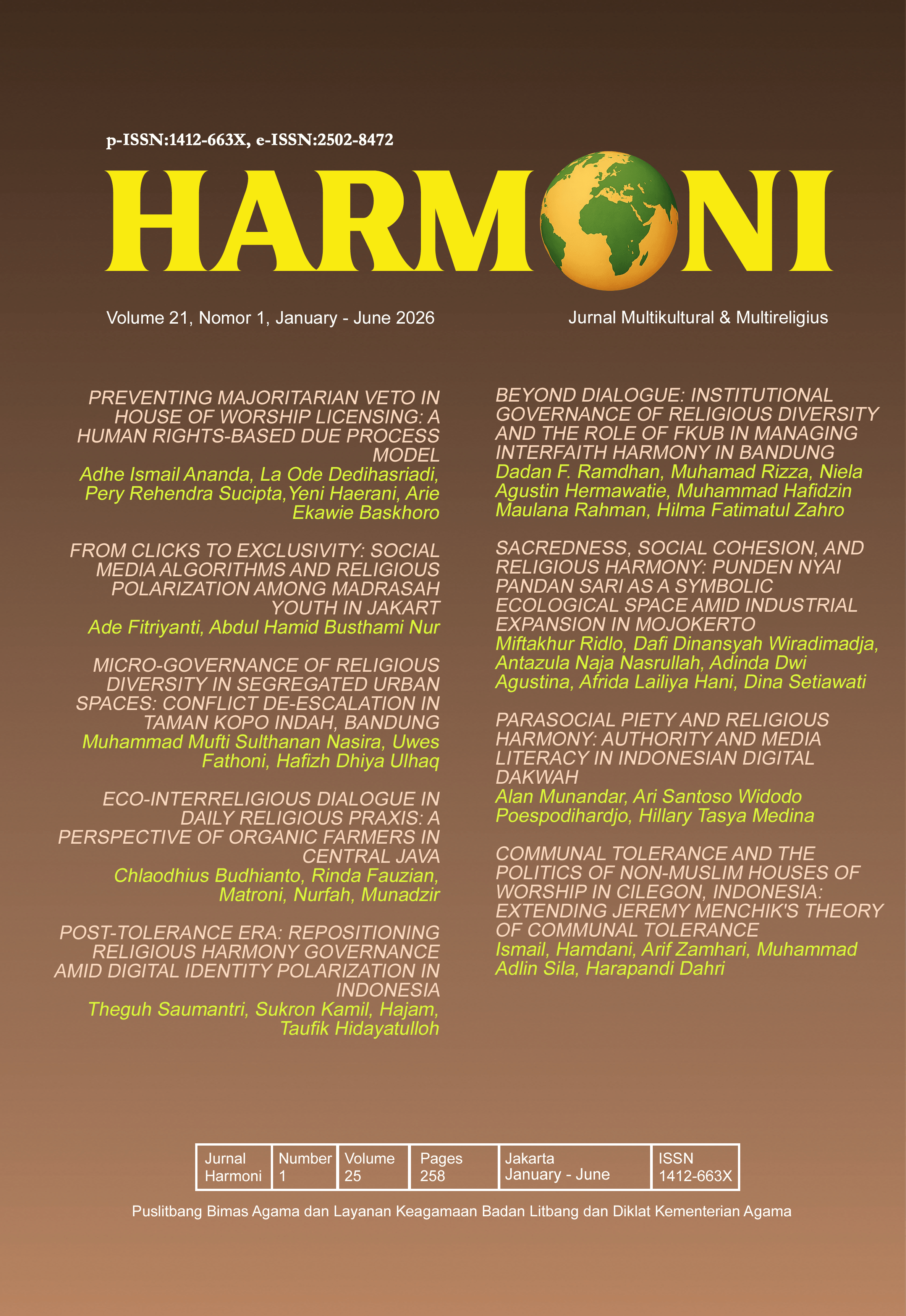
SACREDNESS, SOCIAL COHESION, AND RELIGIOUS HARMONY: PUNDEN NYAI PANDAN SARI AS A SYMBOLIC ECOLOGICAL SPACE AMID INDUSTRIAL EXPANSION IN MOJOKERTO
DOI:
https://doi.org/10.32488/harmoni.v25i1.1073Keywords:
local mythology, sacred space, ecological resistance, symbolic ecology, local wisdom, industrial expansionAbstract
This study examines Punden Nyai Pandan Sari in Unengan Hamlet, Sekargadung Village, Mojokerto Regency, as a sacred space that mediates ecological ethics amid industrial expansion. Drawing on symbolic ecology, sacred natural site studies, and lived religion, the study addresses the gap between research on industrial ecology, sacred natural sites, and lived religion by asking how local sacredness shapes social cohesion, religious harmony, and symbolic ecological resistance. Using a qualitative case study with environmental ethnography, data were collected over two months of fieldwork, participatory observation, documentation, and ten semi-structured interviews with the punden custodian, village figures, a religious leader, residents, youth, and pilgrims, and were then analyzed using thematic analysis. The findings show that oral traditions about Nyai Pandan Sari, Punden Kemloko as the “vehicle” symbol, Snake Cave narratives, pilgrimage, tahlil, tawasul, and unwritten prohibitions construct the punden as a symbolic ecological space. Its sacredness governs everyday behavior by encouraging visitors and residents to maintain cleanliness, respect the trees, avoid damaging the area, and follow visiting etiquette. Rather than producing direct opposition to industry, the punden supports non-confrontational ecological resistance through care, memory, ritual, and collective participation. The study contributes to religious harmony and environmental studies by showing that local wisdom can transform sacred space into a moral-cultural boundary that links humans, God, ancestors, community, and nature. It suggests that village-based governance should recognize such spaces as cultural and ecological assets while avoiding excessive claims beyond ethnographic evidence for communities experiencing rapid spatial and socio-economic transformation in industrial villages today.
Abstrak
Penelitian ini mengkaji Punden Nyai Pandan Sari di Dusun Unengan, Desa Sekargadung, Kabupaten Mojokerto, sebagai ruang sakral yang memediasi etika ekologi di tengah ekspansi industri. Mengacu pada ekologi simbolik, studi situs alam suci, dan agama hidup, studi ini membahas kesenjangan antara penelitian tentang ekologi industri, situs alam suci, dan agama hidup dengan menanyakan bagaimana kesakralan lokal membentuk kohesi sosial, harmoni beragama, dan perlawanan ekologis simbolis. Dengan menggunakan studi kasus kualitatif dengan etnografi lingkungan, data dikumpulkan selama dua bulan kerja lapangan melalui observasi partisipatif, dokumentasi, dan sepuluh wawancara semi-terstruktur dengan penjaga punden, tokoh desa, tokoh agama, warga, pemuda, dan peziarah, kemudian dianalisis menggunakan analisis tematik. Temuan tersebut menunjukkan bahwa tradisi lisan tentang Nyai Pandan Sari, Punden Kemloko sebagai simbol "kendaraan", narasi Gua Ular, ziarah, tahlil, tawasul, serta larangan tidak tertulis untuk membangun punden sebagai ruang ekologis simbolis. Kesakralannya mengatur perilaku sehari-hari dengan mendorong pengunjung dan penduduk untuk menjaga kebersihan, menghormati pepohonan, menghindari kerusakan area, serta mematuhi etika kunjungan. Alih-alih menghasilkan oposisi langsung terhadap industri, pakar mendukung perlawanan ekologis non-konfrontatif melalui perawatan, ingatan, ritual, dan partisipasi kolektif. Studi ini berkontribusi pada keharmonisan agama dan studi lingkungan dengan menunjukkan bahwa kearifan lokal dapat mengubah ruang suci menjadi batas moral-budaya yang menghubungkan manusia, Tuhan, leluhur, komunitas, dan alam. Ini menyarankan bahwa tata kelola berbasis desa harus mengakui ruang tersebut sebagai aset budaya dan ekologis, sambil menghindari klaim berlebihan di luar bukti etnografi, bagi masyarakat yang mengalami transformasi spasial dan sosial-ekonomi yang cepat di desa-desa industri saat ini.
Downloads
References
Ágoston, C., Csaba, B., Nagy, B., Kőváry, Z., Dúll, A., Rácz, J., & Demetrovics, Z. (2022). Identifying Types of Eco-Anxiety, Eco-Guilt, Eco-Grief, and Eco-Coping in a Climate-Sensitive Population: A Qualitative Study. International Journal of Environmental Research and Public Health, 19(4), 2461. https://doi.org/10.3390/ijerph19042461
Akbari, R., Hasanzadeh, M., Motamedi, M., & Asgharpourmasouleh, A. (2024). “Ambivalence of the Sacred”: Cultural Dynamics of Religion and Peace. Religious Inquiries, (Online First). https://doi.org/10.22034/ri.2020.240492.1422
American Psychological Association & ecoAmerica. (2017). Mental Health and Our Changing Climate: Impacts, Implications, and Guidance: (503122017-001) [Dataset]. https://doi.org/10.1037/e503122017-001
Braun, V., & Clarke, V. (2006). Using thematic analysis in psychology. Qualitative Research in Psychology, 3(2), 77-101. https://doi.org/10.1191/1478088706qp063oa
Miles, M. B., & Huberman, A. M. (1994). Qualitative Data Analysis: An Expanded Sourcebook (2nd ed.). Sage Publications.
Bhagwat, S. A., & Rutte, C. (2006). Sacred groves: Potential for biodiversity management. Frontiers in Ecology and the Environment, 4(10), 519–524. https://doi.org/10.1890/1540-9295(2006)4%255B519:SGPFBM%255D2.0.CO;2
Coffey, Y., Bhullar, N., Durkin, J., Islam, M. S., & Usher, K. (2021). Understanding Eco-anxiety: A Systematic Scoping Review of Current Literature and Identified Knowledge Gaps. The Journal of Climate Change and Health, 3, 100047. https://doi.org/10.1016/j.joclim.2021.100047
Colding, J., & Folke, C. (2001). Social Taboos: “Invisible” Systems of Local Resource Management and Biological Conservation. Ecological Applications, 11(2), 584. https://doi.org/10.2307/3060911
Dawson, A. (2024). Traditional Ecological Knowledge in Climate Change Research: Insights from Sacred Ecology [Application/pdf]. https://doi.org/10.48785/100/289
Dudley, N., Higgins‐Zogib, L., & Mansourian, S. (2009). The Links between Protected Areas, Faiths, and Sacred Natural Sites. Conservation Biology, 23(3), 568–577. https://doi.org/10.1111/j.1523-1739.2009.01201.x
Falaq, Y. (2024). Jamasan Kendeng as a Religious Moderation Practice for Environmental Protection. Scaffolding: Jurnal Pendidikan Islam Dan Multikulturalisme, 6(3), 567–582. https://doi.org/10.37680/scaffolding.v6i3.7095
Gavrilescu, M., Demnerová, K., Aamand, J., Agathos, S., & Fava, F. (2015). Emerging pollutants in the environment: Present and future challenges in biomonitoring, ecological risks and bioremediation. New Biotechnology, 32(1), 147–156.
Gede Agung, D. A., Nasih, A. M., Sumarmi, Idris, & Kurniawan, B. (2024). Local wisdom as a model of interfaith communication in creating religious harmony in Indonesia. Social Sciences & Humanities Open, 9, 100827. https://doi.org/10.1016/j.ssaho.2024.100827
Gülüm, E. (2023). Folkloric memory: (Re)connecting the dots for broader perspectives. Memory Studies, 16(6), 1466–1483. https://doi.org/10.1177/17506980231204175
Himes, A., Muraca, B., Anderson, C. B., Athayde, S., Beery, T., Cantú-Fernández, M., González-Jiménez, D., Gould, R. K., Hejnowicz, A. P., Kenter, J., Lenzi, D., Murali, R., Pascual, U., Raymond, C., Ring, A., Russo, K., Samakov, A., Stålhammar, S., Thorén, H., & Zent, E. (2024). Why nature matters: A systematic review of intrinsic, instrumental, and relational values. BioScience, 74(1), 25–43. https://doi.org/10.1093/biosci/biad109
Ibrahim Siregar & Suheri Sahputra Rangkuti. (2024). Ecological Religious-Cultural: New Direction of Ecological Paradigm in the Integration Frame of Maqashid Sharia and Tapanuli Indigenous Religious Concepts. DINIKA : Academic Journal of Islamic Studies, 9(1), 1–24. https://doi.org/10.22515/dinika.v9i1.9013
Jamil, I. R., Ananda Sintia Putri, & Nur Azizah Arianggi Suryaatmaja. (2023). Evaluating Green Efficiency of Manufacture Sector and Its Determinants in East Java Province. East Java Economic Journal, 7(1), 90–108. https://doi.org/10.53572/ejavec.v7i1.90
Kalland, A. (2003). Environmentalism and Images of the Other. In Nature across cultures: Views of nature and the environment in non-western cultures (pp. 1–17). Springer.
Karim, A., Raya, Moch. K. F., Mutholib, A., Kawakip, A. N., Retnanto, A., & Mukroji. (2023). Nyai Sabirah’s folklore and sacred local heritage in Central Java. Cogent Arts & Humanities, 10(1), 2198629. https://doi.org/10.1080/23311983.2023.2198629
Kennedy, C. M., Fariss, B., Oakleaf, J. R., Garnett, S. T., Fernández-Llamazares, Á., Fa, J. E., Baruch-Mordo, S., & Kiesecker, J. (2023). Indigenous Peoples’ lands are threatened by industrial development; conversion risk assessment reveals need to support Indigenous stewardship. One Earth, 6(8), 1032–1049. https://doi.org/10.1016/j.oneear.2023.07.006
Klemeš, J. J., Fan, Y. V., & Jiang, P. (2021). Plastics: Friends or foes? The circularity and plastic waste footprint. Energy Sources, Part A: Recovery, Utilization, and Environmental Effects, 43(13), 1549–1565.
Kong, L. (2001). Mapping ‘new’ geographies of religion: Politics and poetics in modernity. Progress in Human Geography, 25(2), 211–233. https://doi.org/10.1191/030913201678580485
Lopez, C., Van Alphen, F., & Carmona, L. (2025). Narratives and collective memory. Current Opinion in Psychology, 65, 102087. https://doi.org/10.1016/j.copsyc.2025.102087
Maran, T., & Kull, K. (2014). Ecosemiotics: Main principles and current developments. Geografiska Annaler: Series B, Human Geography, 96(1), 41–50. https://doi.org/10.1111/geob.12035
Mossière, G. (2009a). Meredith B. McGuire, Lived Religion. Faith and Practice in Everyday Life: New York, Oxford University Press, 2008, 304 p. Archives de sciences sociales des religions, 148, 75–342. https://doi.org/10.4000/assr.21167
Nasution, S. I., Purnama, R., & Puspita, V. D. (2025). Peran Persepsi Risiko Lingkungan sebagai Mediator Dalam Hubungan antara Eco-Anxiety Dan Perilaku Pro-Lingkungan di Kalangan Gen Z di Lampung. PSIKODIMENSIA, 24(2), 172–186. https://doi.org/10.24167/psidim.v24i2.14410
O’Connor, P. (2022). The unanchored past: Three modes of collective memory. Memory Studies, 15(4), 634–649. https://doi.org/10.1177/1750698019894694
Paramita, A. O., Partelow, S., Schlüter, A., & Buhari, N. (2023). Can the Indonesian collective action norm of Gotong-Royong be strengthened with economic incentives? Comparing the implementation of an aquaculture irrigation policy program. International Journal of the Commons, 17(1). https://doi.org/10.5334/ijc.1273
Reeves, S., Kuper, A., & Hodges, B. D. (2008). Qualitative research methodologies: Ethnography. BMJ, 337(aug07 3), a1020–a1020. https://doi.org/10.1136/bmj.a1020
Sacralization of natural environment and the socio-religious conditions of the South Coast of Java. (2023). Kasetsart Journal of Social Sciences, 44(4). https://doi.org/10.34044/j.kjss.2023.44.4.24
Schiefer, D., & Van Der Noll, J. (2017). The Essentials of Social Cohesion: A Literature Review. Social Indicators Research, 132(2), 579–603. https://doi.org/10.1007/s11205-016-1314-5
Seto, K. C., Güneralp, B., & Hutyra, L. R. (2012). Global forecasts of urban expansion to 2030 and direct impacts on biodiversity and carbon pools. Proceedings of the National Academy of Sciences, 109(40), 16083–16088. https://doi.org/10.1073/pnas.1211658109
Singh, P., Tewari, S., Kesberg, R., Karl, J. A., Bulbulia, J., & Fischer, R. (2020). Time investments in rituals are associated with social bonding, affect and subjective health: A longitudinal study of Diwali in two Indian communities. Philosophical Transactions of the Royal Society B: Biological Sciences, 375(1805), 20190430. https://doi.org/10.1098/rstb.2019.0430
Sponsel, L. (2020). Introduction to “Religious Environmental Activism in Asia: Case Studies in Spiritual Ecology.” Religions, 11(2), 77. https://doi.org/10.3390/rel11020077
Sullivan, M. K., Browne, L., Penagos Zuluaga, J. C., Liu, J., Surendra, A., & Estrada‐Villegas, S. (2024). Sacred forest biodiversity conservation: A meta‐analysis. Conservation Science and Practice, 6(1), e13055. https://doi.org/10.1111/csp2.13055
Syam, C., Olendo, Y. O., Dewantara, J. A., & Rahmani, E. F. (2024). Oral literature and social identity of the Dayak Kanayatn: The extinction of oral literature in the midst of contemporary cultural trends. Cogent Arts & Humanities, 11(1), 2376785. https://doi.org/10.1080/23311983.2024.2376785
Talema, A. H., & Nigusie, W. B. (2023). Impacts of urban expansion on the livelihoods of local farming communities: The case of Burayu town, Ethiopia. Heliyon, 9(3), e14061. https://doi.org/10.1016/j.heliyon.2023.e14061
Tatay, J., & Merino, A. (2023a). What is sacred in sacred natural sites? A literature review from a conservation lens. Ecology and Society, 28(1), art12. https://doi.org/10.5751/ES-13823-280112
Utami, W. S., Harmanto, H., Zein, I. M., Prastiyono, H., & Al Amin, M. N. F. (2024). Evaluation of Mojokerto City Regional Expansion as a Sustainable Effort for Service Center Functions. In G. W. Pradana, D. F. Eprilianto, D. Perwitasari, R. Riyadi, Moh. Mudzakkir, & S. Megawati (Eds.), Proceedings of the 4th International Conference on Social Sciences and Law (ICSSL 2024) (Vol. 877, pp. 167–179). Atlantis Press SARL. https://doi.org/10.2991/978-2-38476-303-0_17
Utomo, F. S., Mibtadin, Wibowo, P. A. W., & Widodo, S. T. (2025). Sacred Ecology: Spirituality and Environmental Ethics in the Traditional Art of Sandur Bojonegoro. In P. A. W. Wibowo, D. Susanto, & M. Mibtadin (Eds.), Proceedings of the International Conference on Cultural Studies (ICCUS) 2024 (Vol. 930, pp. 264–277). Atlantis Press SARL. https://doi.org/10.2991/978-2-38476-418-1_20
Verschuuren, B. (with McNeely, J., Oviedo, G., & Wild, R.). (2010). Sacred Natural Sites: Conserving Nature and Culture. Taylor & Francis Group.
Verschuuren, B., & Furuta, N. (2016). Asian sacred natural sites: Philosophy and practice in protected areas and conservation. Routledge.
Woodward, M. (2010). Java, Indonesia and Islam (Vol. 3). Springer Science & Business Media.
Zannini, P., Frascaroli, F., Nascimbene, J., Persico, A., Halley, J. M., Stara, K., Midolo, G., & Chiarucci, A. (2021). Sacred natural sites and biodiversity conservation: A systematic review. Biodiversity and Conservation, 30(13), 3747–3762. https://doi.org/10.1007/s10531-021-02296-3
Downloads
Published
Issue
Section
License
Copyright (c) 2026 miftakhur ridlo, Dafi Dinansyah Wiradimadja, Antazula Naja Nasrullah, Adinda Dwi Agustina, Afrida Lailiya Hani, Dina Setiawati

This work is licensed under a Creative Commons Attribution-NonCommercial-ShareAlike 4.0 International License.