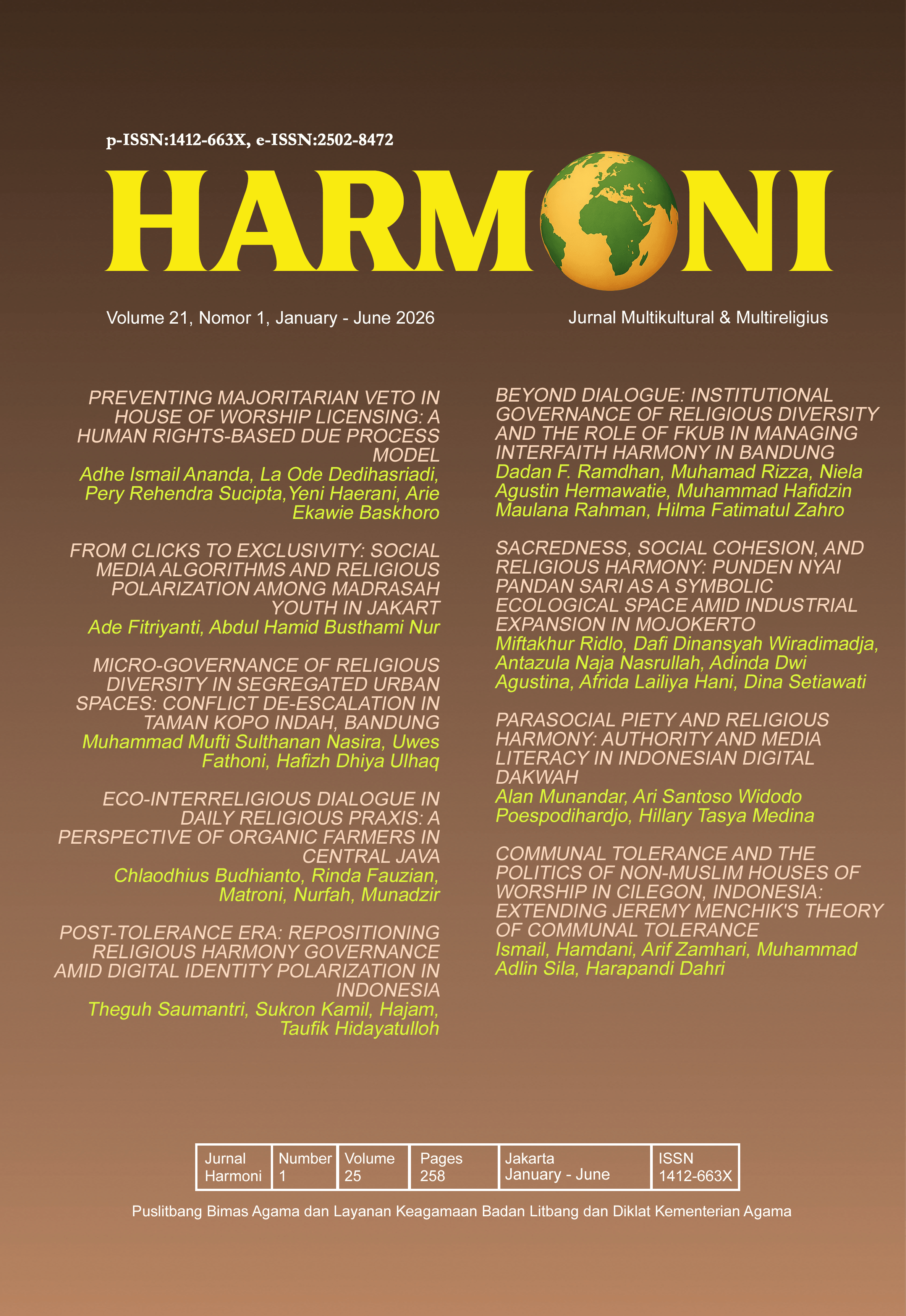
PARASOCIAL PIETY AND RELIGIOUS HARMONY: AUTHORITY AND MEDIA LITERACY IN INDONESIAN DIGITAL DAKWAH
DOI:
https://doi.org/10.32488/harmoni.v25i1.1072Keywords:
Digital dakwah, Digital literacy, Parasocial pietyAbstract
Indonesia's rapid digital expansion has transformed how Muslims access religious guidance, enabling digital preachers to build asymmetrical, emotionally significant bonds with millions of followers, a phenomenon this study conceptualizes as parasocial piety. In Indonesia's plural democratic society, where religious moderation (moderasi beragama) is a national policy priority, these parasocial dynamics carry consequential implications for social cohesion, interfaith discourse, and digital religious authority. This study explains the communicative mechanisms through which parasocial piety emerges in Indonesian digital dakwah, assesses its effects on religious moderation and social cohesion, and formulates an applied religious media literacy framework as an intervention response. Using an interpretive qualitative design with an integrative literature review, the article synthesizes peer-reviewed scholarship published mainly between 2021 and 2026, covering digital dakwah, parasocial interaction and relationship theory, Digital Islam, religious moderation, and digital religious literacy. Sources were selected through systematic screening following SALSA criteria, yielding a final corpus of 44 peer-reviewed journal articles. Findings identify five platform-conditioned mechanisms, including rhythmic presence, visual authority, and commodification of piety, that jointly produce mediated religious influence capable of both supporting and weakening religious moderation and inclusive discourse. The study contributes an original three-level ethical literacy framework for creators, audiences, and institutional ecosystems, with direct relevance to religious harmony policy in Indonesia's plural digital public sphere.
Abstrak
Ekspansi digital yang pesat di Indonesia telah mengubah cara umat Muslim mengakses bimbingan agama, memungkinkan dai digital membangun ikatan satu arah yang bermakna secara emosional dengan jutaan pengikut, fenomena yang dikonseptualisasikan dalam studi ini sebagai parasocial piety. Dalam masyarakat Indonesia yang plural dan demokratis, di mana moderasi beragama menjadi prioritas kebijakan nasional, dinamika parasosial ini membawa implikasi serius terhadap kohesi sosial, wacana lintas agama, dan otoritas keagamaan digital. Studi ini menjelaskan mekanisme komunikatif kemunculan parasocial piety dalam dakwah digital Indonesia, mengkaji dampaknya terhadap moderasi beragama dan kohesi sosial, serta merumuskan kerangka literasi media keagamaan terapan sebagai respons intervensi. Dengan desain kualitatif interpretatif dan integrative literature review, artikel ini mensintesis karya ilmiah peer-reviewed yang dipublikasikan dominan antara 2021 hingga 2026, mengenai dakwah digital, teori interaksi dan relasi parasosial, Digital Islam, moderasi beragama, dan literasi digital keagamaan. Sumber dipilih melalui penyaringan sistematis berdasarkan kriteria SALSA, sehingga menghasilkan korpus akhir sebanyak 44 artikel jurnal peer-reviewed. Temuan mengidentifikasi lima mekanisme berbasis platform, termasuk kehadiran ritmis, otoritas visual, dan komodifikasi kesalehan, yang secara bersama menghasilkan pengaruh keagamaan termediasi yang dapat sekaligus mendukung dan melemahkan moderasi beragama serta wacana inklusif. Studi ini berkontribusi melalui kerangka literasi etis tiga level bagi kreator, audiens, dan ekosistem institusional, dengan relevansi langsung terhadap kebijakan kerukunan beragama dalam ruang publik digital plural Indonesia.
Downloads
References
Afidah, I., Kurniati, N., Nasir, M. A., & Muttaqin, A. (2024). Religious micro-celebrity: Young preachers’ self-presentation in digital sphere. Alhadharah: Jurnal Ilmu Dakwah, 23(2), 227–245. https://jurnal.uin-antasari.ac.id/index.php/alhadharah/article/view/13680
A’lan Tabaika, M., & Roibin, R. (2025). Digital dawah and the reconstruction of Islamic authority. Al-Balagh : Jurnal Dakwah Dan Komunikasi, 10(2). https://doi.org/10.22515/albalagh.v10i2.12116
AlMazaedh, I., Tahat, K. M., Alkhalaileh, M., & Tahat, D. N. (2026). Digital religion in platform societies: authority, mediation, and social cohesion in algorithmic publics (2010–2025). Frontiers in Sociology, 11. https://doi.org/10.3389/fsoc.2026.1802281
Arafah, B., & Hasyim, M. (2023). Digital literacy: The right solution to overcome the various problems of meaning and communication on social media. Studies in Media and Communication, 11(4), 19. https://doi.org/10.11114/smc.v11i4.6003
Badan Pusat Statistik. (2023). Statistik Indonesia 2023. BPS-Statistics Indonesia. https://www.bps.go.id
Baulch, E., & Pramiyanti, A. (2018). Hijabers on Instagram: Using visual social media to construct the ideal Muslim woman. Social Media + Society, 4(4). https://doi.org/10.1177/2056305118800308
Braun, V., & Clarke, V. (2021). One size fits all? What counts as quality practice in (reflexive) thematic analysis? Qualitative Research in Psychology, 18(3), 328–352. https://doi.org/10.1080/14780887.2020.1769238
Burhani, A. N. (2018). Pluralism, liberalism, and Islamism: Religious outlook of Muhammadiyah. Studia Islamika, 25(3), 433–470. https://doi.org/10.15408/sdi.v25i3.7765
Campbell, H. A. (2012). Understanding the relationship between religion online and offline in a networked society. Journal of the American Academy of Religion, 80(1), 64–93. https://doi.org/10.1093/jaarel/lfr074
Chan, J., To, H.-P., & Chan, E. (2006). Reconsidering social cohesion: Developing a definition and analytical framework for empirical research. Social Indicators Research, 75(2), 273–302. https://doi.org/10.1007/s11205-005-2118-1
Cho, Y. (2022). Comparing integrative and systematic literature reviews. Human Resource Development Review, 21(2), 147–151. https://doi.org/10.1177/15344843221089053
Dewanti, Y., Ifthiharfi, R., Hamka, M. A., Ruciswandaru, R., Syarif, A. S., & Seniati, A. N. L. (2025). Development and validation of the parasocial relationships with religious figures scale. INSPIRA: Indonesian Journal of Psychological Research, 6(1). https://doi.org/10.32505/inspira.v6i1.11011
Djafarova, E., & Rushworth, C. (2017). Exploring the credibility of online celebrities’ Instagram profiles in influencing the purchase decisions of young female users. Computers in Human Behavior, 68, 1–7. https://doi.org/10.1016/j.chb.2016.11.009
Fain, J. A. (2024). Distinguishing between integrative and systematic literature reviews. The Science of Diabetes Self-Management and Care, 50(2), 105–106. https://doi.org/10.1177/26350106241245659
Famuji, U., Nuri Nurhaidah, S., Pramula, B., & Yasin, F. (2025). Komunikasi parasosial dai milenial: Strategi intimasi di Instagram dan TikTok. Liwaul Dakwah: Jurnal Kajian Dakwah Dan Masyarakat Islam, 15(2), 149–161. https://doi.org/10.47766/LIWAULDAKWAH.V15I2.7081
Febrian, H. (2024). Visualizing authority: Rise of the religious influencers on the Instagram. Social Media + Society, 10(4). https://doi.org/10.1177/20563051241286850
Febrianto, M., & Muhid, A. (2025). Digital da’wah for Generation Z: Strategies and challenges in building spiritual awareness. Journal International Dakwah and Communication, 5(1), 35–51. https://doi.org/10.55849/jidc.v5i1.893
Hanifansyah, N., Arifin, A., Zulpina, Z., Mahmudah, M., & Syaheed, S. M. (2025). Religious drama controversy: The impact of bidaah on Islamic pedagogy and media literacy. MIQOT: Jurnal Ilmu-Ilmu Keislaman, 49(2), 314. https://doi.org/10.30821/miqot.v49i2.1407
Hanipah, H., Djou, D. N., & Muslimin. (2025). When intolerant language crowds the feed: How digital discourses reconstruct religious freedom in Indonesia. Harmoni, 24(2), 281–298. https://doi.org/10.32488/harmoni.v24i2.929
Hannan, A., & Mursyidi, A. F. (2023). Social media and the fragmentation of religious authority among Muslims in contemporary Indonesia. Digital Muslim Review, 1(2), 84–104. https://doi.org/10.32678/dmr.v1i2.10
Hanung, S. R., Zulkifli, & Nashrul, H. (2025). Mediatization and hypermediation in digital religion and the transformation of Indonesian Muslim religious practices through social media usage. Jurnal Sosiologi Agama, 18(2), 133–150. https://doi.org/10.14421/jsa.2024.182-01
Haq, S. U., & Kwok, R. Y. (2024). Encountering “the other” in religious social media: A cross-cultural analysis. Social Media + Society, 10(4). https://doi.org/10.1177/20563051241303363
Hatami, H., Anisah, H. U., Fitria, R. S., & Fauziannor, A. (2025). Islamic digital communication and the changing meanings of religious values: A discourse analysis of AI and social media. Al-I’lam: Jurnal Komunikasi Dan Penyiaran Islam, 9(1), 38. https://doi.org/10.31764/jail.v9i1.35284
Ibad, M. N. (2025). Strategi literasi dakwah digital di era media sosial TikTok: Tantangan dan peluang. Pelita: Jurnal Studi Islam Mahasiswa UII Dalwa, 2(2), 145–156. https://doi.org/10.38073/pelita.v2i2.2189
Ichwan, Moh. N., Amin, F., Khusairi, A., & Andrian, B. (2024). Digitalization and the shifting religious literature of Indonesian Muslims in the era of Society 5.0. Islamic Communication Journal, 9(2), 245–266. https://doi.org/10.21580/icj.2024.9.2.22515
Junaidi, J., & Tanshzil, S. W. (2025). Religious moderation research (2016–2025): Systematic review and bibliometric mapping. Harmoni, 24(2), 185–214. https://doi.org/10.32488/harmoni.v24i2.888
Lou, C. (2022). Social media influencers and followers: Theorization of a trans-parasocial relation and explication of its implications for influencer advertising. Journal of Advertising, 51(1), 4–21. https://doi.org/10.1080/00913367.2021.1880345
Marwick, A. E., & boyd, danah. (2011). I tweet honestly, I tweet passionately: Twitter users, context collapse, and the imagined audience. New Media & Society, 13(1), 114–133. https://doi.org/10.1177/1461444810365313
Missier, C. A. (2025). A qualitative study of digital religious influence: Perspectives from Christian, Hindu, and Muslim Gen Y and Gen Z in Mumbai, India. Religions, 16(1), 73. https://doi.org/10.3390/rel16010073
Nafahatus, N., Al-Ulya, S., Jamil, A. N., Qomariyah, N., & Sahri, I. K. (2025). Digital religious literacy and religious moderation among madrasah students in Batu City: A case study. Indonesian Journal of Islamic Education, 12(2), 149. https://ejournal.upi.edu/index.php/tarbawy/index
Nur Rifqah, N., & Maksum, Muh. N. R. (2024). Dinamika dakwah Islam dalam menghadapi tantangan di era digital: Perspektif Nahdlatul Ulama dan Muhammadiyah. AT-TAWASUL, 3(2), 90–101. https://doi.org/10.51192/ja.v3i2.1032
Polanco-Levicán, K., & Salvo-Garrido, S. (2022). Understanding social media literacy: A systematic review of the concept and its competences. International Journal of Environmental Research and Public Health, 19(14), 8807. https://doi.org/10.3390/ijerph19148807
Rachman, A., Saumantri, T., & Hidayatulloh, T. (2025). Transformation of religious authority in the digital era: A post-normal times analysis by Ziauddin Sardar on the phenomenon of social media da’wah. Jurnal Ilmu Dakwah, 45(1), 107–122. https://doi.org/10.21580/jid.v45.1.25644
Raya, Moch. K. F. (2025). Digital Islam: new space for authority and religious commodification among Islamic preachers in contemporary Indonesia. Contemporary Islam, 19(1), 161–194. https://doi.org/10.1007/s11562-024-00570-z
Ridho, A., Sartika, A., Tahir Alibe, M., & Hisyam Tahrus, Z. N. (2025). Multimodal strategies of moderate Islamic digital da’wah on the Rukun Indonesia YouTube channel. Harmoni, 24(2), 380–407. https://doi.org/10.32488/harmoni.v24i2.900
Rusadi, B. E., & Syamsul, A. (2023). Religious digital literacy of Islamic education students at Indonesia State Islamic University. TADRIS: Jurnal Pendidikan Islam, 18(1), 90–110. https://doi.org/10.19105/tjpi.v18i1.8305
Sanityastuti, M., Virga, R. L., & Zahra, L. (2025). Understanding digital literacy in religious content on social media: @generation_muda_nu and @kuntummagazine study. Profetik: Jurnal Komunikasi, 17(1). https://doi.org/10.14421/pjk.v17i1.3062
Schramm, H., Liebers, N., Biniak, L., & Dettmar, F. (2024). Research trends on parasocial interactions and relationships with media characters. A review of 281 English and German-language studies from 2016 to 2020. Frontiers in Psychology, 15. https://doi.org/10.3389/fpsyg.2024.1418564
Sheng, J., Kostyk, A., & Chatzipanagiotou, K. (2025). From parasocial interaction to parasocial relationship: A review and research agenda. International Journal of Consumer Studies, 49(2). https://doi.org/10.1111/ijcs.70038
Stein, J.-P., Linda Breves, P., & Anders, N. (2024). Parasocial interactions with real and virtual influencers: The role of perceived similarity and human-likeness. New Media & Society, 26(6), 3433–3453. https://doi.org/10.1177/14614448221102900
Taufikurrahman, T., & Setyowati, E. (2024). Sistem komunikasi dakwah di era digital melalui Instagram, TikTok, YouTube. Al-Mada: Jurnal Agama, Sosial, Dan Budaya, 7(1), 103–116. https://e-journal.uac.ac.id/index.php/almada/article/view/4866
Wahyuningsih, F., Hakki, S., & Susanti, R. (2025). Preaching through social media in Islamic religious education: Analysis of effectiveness and challenges in increasing religious awareness. Journal of Higher Education and Academic Advancement, 2(9), 400–410. https://doi.org/10.61796/ejheaa.v2i9.1371
Zaid, B., Fedtke, J., Shin, D. D., El Kadoussi, A., & Ibahrine, M. (2022). Digital Islam and Muslim millennials: How social media influencers reimagine religious authority and Islamic practices. Religions, 13(4), 335. https://doi.org/10.3390/rel13040335
Zhou, X., Huang, Y., & Inoue, Y. (2024). Parasocial interactions and parasocial relationships on Instagram: An in-depth analysis of fashion and beauty influencers. Heliyon, 10(21), e39708. https://doi.org/10.1016/j.heliyon.2024.e39708
Downloads
Published
Issue
Section
License
Copyright (c) 2026 Alan Munandar, Ari Santoso Widodo Poespodihardjo, Hillary Tasya Medina

This work is licensed under a Creative Commons Attribution-NonCommercial-ShareAlike 4.0 International License.