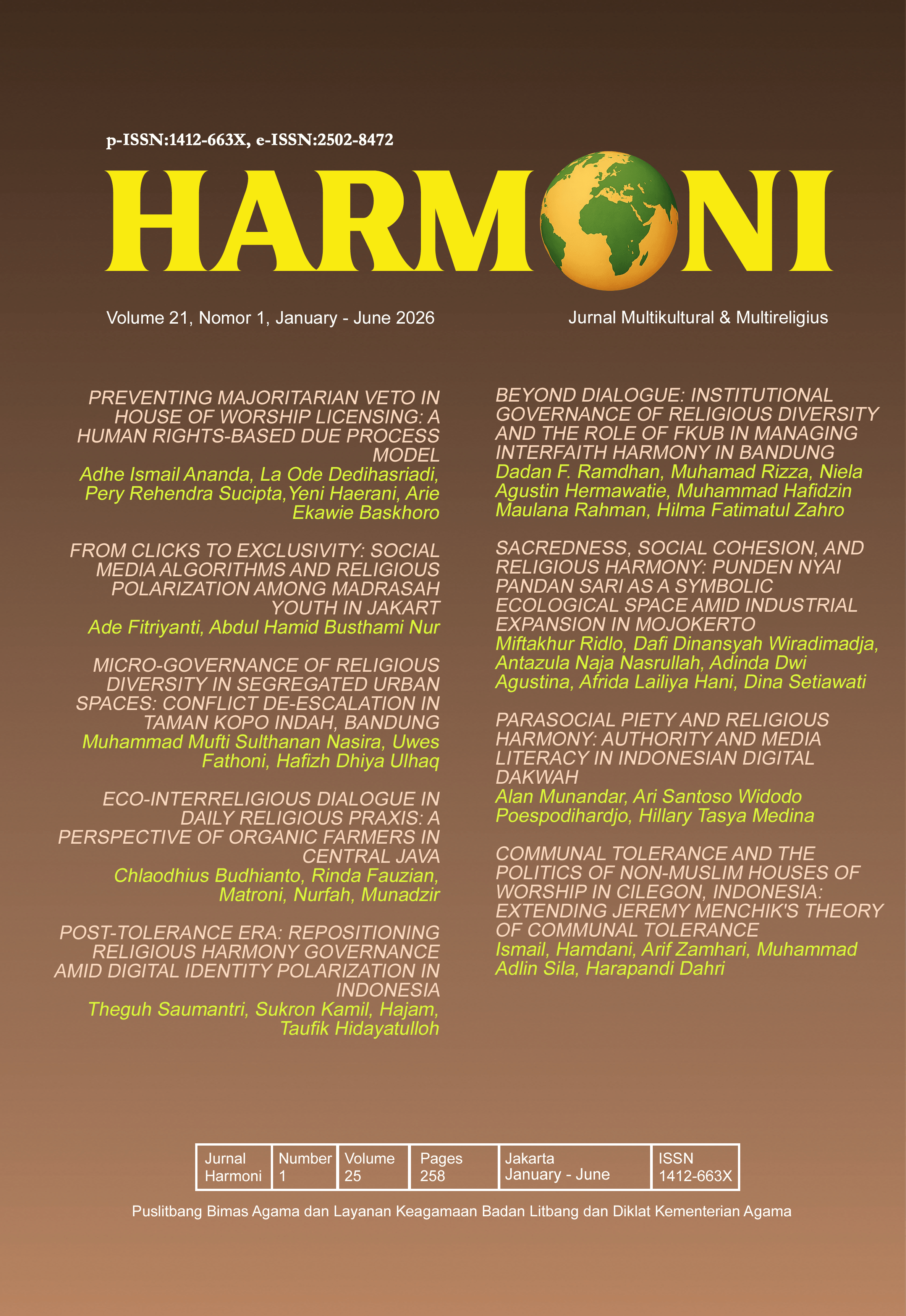
POST-TOLERANCE ERA: REPOSITIONING RELIGIOUS HARMONY GOVERNANCE AMID DIGITAL IDENTITY POLARIZATION IN INDONESIA
DOI:
https://doi.org/10.32488/harmoni.v25i1.1030Keywords:
Post-Tolerance Era, Religious Harmony Governance, Digital Identity Polarization, Collaborative Governance, Digital LiteracyAbstract
The transformation of the digital public sphere has reshaped interreligious interactions and intensified identity polarization, challenging conventional approaches based solely on tolerance and regulation. In plural societies such as Indonesia, these changes influence interfaith dialogue, religious discourse in digital spaces, and social relations among religious communities. The rise of algorithm-driven fragmentation, echo chambers, and the shift of legitimacy from institutional authority to digital influence reflects a significant transformation in religious harmony governance. This study examines how interfaith interaction is patterned within Indonesia's digital public sphere and how religious harmony governance can be repositioned in response to digital identity polarization. Using a descriptive-analytical qualitative approach centred on digital discourse analysis, the study examines 96 posts and 620 user comments collected from X, YouTube, and Facebook between July and December 2025. Data were examined through reduction, coding, discourse analysis, and thematic analysis to identify dominant narratives and meaning-making processes in online religious discussions. The findings indicate that religious harmony can no longer rely solely on stability-oriented approaches based on control and reactive mediation. Instead, it requires collaborative governance that promotes trust-building, digital literacy, and the active participation of multiple stakeholders, including government institutions, religious organizations, civil society, and digital platforms. Building on these findings, the study proposes the post-tolerance era as an analytical framework and develops the Adaptive Religious Harmony Governance model, in which formal tolerance alone is treated as insufficient to sustain social cohesion. Adaptive and participatory mechanisms are needed to respond to the dynamics of digital communication and strengthen constructive interfaith engagement.
Abstrak
Transformasi ruang publik digital telah merekonfigurasi pola interaksi antarumat beragama dan memunculkan polarisasi identitas yang tidak lagi dapat direspons secara memadai melalui pendekatan toleransi normatif dan regulasi administratif. Dalam masyarakat majemuk seperti Indonesia, dinamika ini memengaruhi kualitas interaksi lintas iman, baik dalam bentuk dialog antaragama, pertukaran wacana keagamaan di ruang digital, maupun relasi sosial antar komunitas keagamaan. Fragmentasi wacana berbasis algoritma, menguatnya echo chamber, serta pergeseran legitimasi dari otoritas institusional menuju resonansi digital menunjukkan adanya perubahan struktural dalam tata kelola kerukunan. Penelitian ini bertujuan menganalisis pergeseran paradigma kerukunan antarumat beragama menuju apa yang disebut sebagai post-tolerance era serta merumuskan model reposisi tata kelola yang adaptif dalam menghadapi polarisasi identitas digital. Penelitian ini menggunakan pendekatan kualitatif deskriptif-analitik dengan fokus pada analisis wacana digital terhadap 96 unggahan utama dan 620 komentar pengguna dari platform X, YouTube, dan Facebook yang dikumpulkan pada Juli-Desember 2025. Analisis data dilakukan melalui tahapan reduksi data, kodefikasi, analisis wacana digital (digital discourse analysis), serta analisis tematik untuk mengidentifikasi pola naratif dan konstruksi makna dalam diskursus keagamaan di ruang digital. Temuan penelitian menjelaskan bahwa kerukunan antarumat beragama tidak lagi dapat dipertahankan melalui model stabilitas berbasis kontrol dan mediasi reaktif semata, melainkan memerlukan governance kolaboratif berbasis jaringan yang menekankan trust-building, literasi digital, serta keterlibatan multi-aktor yang mencakup negara, institusi keagamaan lintas iman, organisasi masyarakat sipil, dan platform digital sebagai arena interaksi antaragama. Berdasarkan temuan tersebut, penelitian ini merumuskan post-tolerance era merupakan fase transformasi konseptual dan mengembangkan model Adaptive Religious Harmony Governance, di mana toleransi formal tidak lagi cukup menjaga kohesi sosial dalam relasi lintas agama, tanpa mekanisme deliberatif yang adaptif terhadap struktur komunikasi digital dan mampu memfasilitasi dialog interfaith yang lebih partisipatif.
Downloads
References
Abitolkha, A. M., Alamin, T., Ihsan, N. H., & Huwaida, M. S. (2025). Balanced Engagement: Kiai Ihsan Jampes’ Adaptive Zuhud Framework for Spiritual Transformation in the Digital Era. QIJIS (Qudus International Journal of Islamic Studies), 13(1), 39. https://doi.org/10.21043/qijis.v13i1.22322
Aksa, A., & Nurhayati, N. (2020). Moderasi Beragama Berbasis Budaya Dan Kearifan Lokal Pada Masyarakat Donggo Di Bima (Tinjauan Sosio-Historis). Harmoni, 19(2), 338–352. https://doi.org/10.32488/harmoni.v19i2.449
Ansell, C., & Gash, A. (2018). Collaborative Governance in Theory and Practice. Journal of Public Administration Research and Theory, 18(4), 543–571. https://doi.org/10.1093/jopart/mum032
Aulisio, G. J. (2018). #republic: Divided Democracy in the Age of Social Media. The European Legacy, 23(7–8), 866–867. https://doi.org/10.1080/10848770.2018.1449394
Avgerou, C., Ciborra, C., Cordella, A., Kallinikos, J., & Smith, M. (2015). The Role of Information and Communication Technology in Building Trust in Governance: Towards Effectiveness and Results. Inter-American Development Bank. https://doi.org/10.18235/0012339
Barjah. (2024). Indeks Kerukunan Umat Beragama 2024 Naik Jadi 76,47. Kemenag.Go.Id. https://kemenag.go.id/nasional/indeks-kerukunan-umat-beragama-2024-naik-jadi-76-47-wG2qs
Bellar, W., & Campbell, H. A. (2022). Digital Religion: The Basics. Routledge. https://doi.org/10.4324/9781003058465
Bisri, Hartati, Mustopa, & Saumantri, T. (2024). Navigating modern challenges: The practical role of triple-Relationship of religious moderation through an islamic perspective. Journal of Islamic Thought and Civilization, 14(2), 286–302. https://doi.org/10.32350/jitc.142.17
Campbell, H. A., & Tsuria, R. (2022). Digital Religion Understanding Religious Practice in Digital Media. Routledge.
Chan, M., & Yi, J. (2024). Social Media Use and Political Engagement in Polarized Times. Examining the Contextual Roles of Issue and Affective Polarization in Developed Democracies. Political Communication, 41(5), 743–762. https://doi.org/10.1080/10584609.2024.2325423
Cinelli, M., De Francisci Morales, G., Galeazzi, A., Quattrociocchi, W., & Starnini, M. (2021). The echo chamber effect on social media. Proceedings of the National Academy of Sciences, 118(9). https://doi.org/10.1073/pnas.2023301118
Edelman. (2023). Social fabric weakens amid deepening divisions. Www.Edelman.Com. https://www.edelman.com/trust/2023/trust-barometer
Emerson, K., Nabatchi, T., & Balogh, S. (2022). An Integrative Framework for Collaborative Governance. Journal of Public Administration Research and Theory, 22(1), 1–29. https://doi.org/10.1093/jopart/mur011
Engkizar, E., Kaputra, S., Mutathahirin, M., Syafril, S., Arifin, Z., & Kamaluddin, M. (2022). Model Pencegahan Konflik Antarumat Beragama Berbasis Kegiatan Masyarakat. Harmoni, 21(1), 110–129. https://doi.org/10.32488/harmoni.v21i1.603
Faizin, B. (2024). Polarization of Religious Issues in Indonesia’s Social Media Society and Its Impact on Social Conflict. Journal of Applied Data Sciences, 6(1), 426–442. https://doi.org/10.47738/jads.v6i1.447
Gorwa, R. (2019). What is platform governance? Information, Communication & Society, 22(6), 854–871. https://doi.org/10.1080/1369118X.2019.1573914
Hamdi, A. Z. (2021). Constructing Indonesian Religious Pluralism: The Role of Nahdlatul Ulama in Countering Violent Religious Extremism. JOURNAL OF INDONESIAN ISLAM, 15(2), 433. https://doi.org/10.15642/JIIS.2021.15.2.433-464
Handayani, M. A., & Ali, M. (2020). Antara Agama dan Imajinasi: Identitas Simbol Ibadah dalam Perspektif Postkomunikasi, Postspiritualitas, dan Hiperspiritualitas. Religious: Jurnal Studi Agama-Agama Dan Lintas Budaya, 4(2), 125–134. https://doi.org/10.15575/rjsalb.v4i2.8592
Hansen, H. K., & Flyverbom, M. (2015). The politics of transparency and the calibration of knowledge in the digital age. Organization, 22(6), 872–889. https://doi.org/10.1177/1350508414522315
Jati, W. R., Halimatusa’diah, H., Syamsurijal, S., Aji, G. B., Nurkhoiron, M., & Tirtosudarmo, R. (2022). From Intellectual to Advocacy Movement: Islamic Moderation, the Conservatives and the Shift of Interfaith Dialogue Campaign in Indonesia. Ulumuna, 26(2), 472–499. https://doi.org/10.20414/ujis.v26i2.572
Junaedi, E. (2019). This is religious moderation from the perspective of the ministry of religious affairs. Harmoni, 18(2), 182–186. https://doi.org/10.32488/harmoni.v18i2.414
Junaidi, J., & Tanshzil, S. W. (2025). Religious Moderation Research (2016–2025): Systematic Review and Bibliometric Mapping. Harmoni, 24(2), 185–214. https://doi.org/10.32488/harmoni.v24i2.888
Kanikova, R. K., & Rosalia, F. (2026). Manajemen Konflik Berbasis Komunitas Oleh Forum Kerukunan Umat Beragama (FKUB) Pada Konflik Sosial Keagamaan di Lampung. Journal Publicuho, 9(1), 16–28. https://doi.org/10.35817/publicuho.v9i1.1058
Knut Lundby, G. E. (2021). Theoretical frameworks for approaching religion and new media. Routledge.
Kurniawan, P., Ahmatnijar, A., & Ridwan, M. (2024). The Transformation of Islamic Family Law in the Digital Era: A Sociological Legal Analysis of Marriage and Divorce Regulations in Indonesia. Madania: Jurnal Kajian Keislaman, 28(2), 179. https://doi.org/10.29300/madania.v28i2.5146
Li, Y. (2024). Research methods for digital discourse analysis Research methods for digital discourse analysis. Critical Discourse Studies, 21(3), 379–381. https://doi.org/10.1080/17405904.2022.2149581
Liu, Y., Rakthin, C., & Budianto, L. (2025). Religious Moderation and Community Cohesion: Exploring Social Memory, Identity, and Solidarity in the Phu Khao Thong Muslim Community, Ayutthaya. Millah: Journal of Religious Studies, 24(1), 379–392. https://doi.org/10.20885/millah.vol24.iss1.art10
Marpuah, M. (2019). Toleransi Dan Interaksi Sosial Antar Pemeluk Agama Di Cigugur, Kuningan. Harmoni, 18(2), 51–72. https://doi.org/10.32488/harmoni.v18i2.309
Miles, M. B., Huberman, A. M., & Saldaña, J. (2014). Qualitative Data Analysis: A Methods Sourcebook. SAGE Publications.
Pratap, A. P. (2025). From Public Square to Echo Chamber: The Fragmentation of Online Discourse. ArXiv. View on ArXiv. https://doi.org/10.48550/arXiv.2501.18441
Prats, M., Phillips, E., & Smid, S. (2023). Insights from the 2021 OECD Trust Survey: How people evaluate the trustworthiness of government institutions & implications for policymakers. Behavioral Science & Policy, 9(2), 9–20. https://doi.org/10.1177/23794607241262091
Prayogo, T. I., Zarkasyi, A. F., Arroisi, J., & Indah, N. (2024). Repositioning of Religious Moderation in Indonesia: a Conceptual Analysis Review with Phenomenology Approach. Addin, 18(1), 31. https://doi.org/10.21043/addin.v18i1.22218
Putnam, R. D. (2014). Social Capital and Public Affairs. Bulletin of the American Academy of Arts and Sciences, 47(8), 5. https://doi.org/10.2307/3824796
Qoumas, Y. C., Binti Mohd. Hussain, R. B., & Bin Abdul Rahim, R. A. (2024). The Dissemination of Religious Moderation Through the Policy of the Indonesian Ministry of Religious Affairs. QIJIS (Qudus International Journal of Islamic Studies), 12(1), 147. https://doi.org/10.21043/qijis.v12i1.27552
Rachman, A., Saumantri, T., & Hidayatulloh, T. (2025). Transformation of religious authority in the digital era: A post-normal times analysis by Ziauddin Sardar on the phenomenon of social media da’wah. Jurnal Ilmu Dakwah, 45(1), 107–122. https://doi.org/10.21580/jid.v45.1.25644
Rohmatin, T., Binaningrum, B., Irawan, B., Iman, M. T., & Rahmawati, F. D. (2025). Epistemological Polemics in Digital Religion. Kanz Philosophia: A Journal for Islamic Philosophy and Mysticism, 11(2), 437–454. https://doi.org/10.20871/kpjipm.v11i2.448
Saehu, R., Syarifudin, A., Paramitha, N. A., & Hilmi, F. (2024). Netnographic Study on The Narrative of Marriage at The Office of Religious Affairs (Kua): Opportunities and Challenges. Harmoni, 23(2), 159–179. https://doi.org/10.32488/harmoni.v23i2.793
Sagala, R., & Kandedes, I. (2024). The Role of Islamic Education Teachers in Addressing the Negative Impact of the TikTok on Teenagers in Lampung, Indonesia. Millah: Journal of Religious Studies, 947–990. https://doi.org/10.20885/millah.vol23.iss2.art14
Saprillah, S. (2018). Rumah Ibadah Sebagai Medan Kontestasi Beragama. Harmoni, 16(2), 357–373. https://doi.org/10.32488/harmoni.v16i2.13
Sasea, S. C., Habibi, A. W., & Dewi Anida Nurul, F. (2025). Religious Tolerance in the Digital Age: A Discourse Analysis of the “Log In” Podcast. DISCOURSE: Indonesian Journal of Social Studies and Education, 2(3), 215–226. https://doi.org/10.69875/djosse.v2i3.186
Saumantri, T. (2023). Religious Moderation in a Plural Society: Study of Tolerance Village in Bandung City. Kontekstualita: Journal of Social and Religious Research, 38(1), 27–44. https://doi.org/10.30631/38.01.21-32
Saumantri, T., Hidayatulloh, T., Sumanta, & Asmuni, A. (2025). Tolerance in the Theology of Islamic Reform: A Hermeneutic Reading of Muhammad Ali Jinnah’s Thought. International Journal of Islamic Thought, 27(June), 160–170. https://doi.org/10.24035/ijit.27.2025.326
Shihab, M. Q. (2020). Wasathiyyah: Islamic Insights on Religious Moderation. Lentera Hati.
Supriadi, D., Sanusi, A., Reslawati, R., Burhanudin, D., & Pinem, M. (2026). Religious Traditions and Cultural Integration: Pathways to Harmonization and the Promotion of Moderation in Contemporary Muslim Societies. Journal of Islamic Thought and Civilization, 16(1), 110–126. https://doi.org/10.32350/jitc.161.07
Syahbudi. (2025). The Exploration of Religious Moderation Discourse as a New Form of Nationalism in the Indonesian Government. Afkaruna: Indonesian Interdisciplinary Journal of Islamic Studies, 21(2), 199–216. https://doi.org/10.18196/afkaruna.v21i2.22086
Taja, N., Hakim, A., Suhardini, A. D., Baehaqi, R., & Pamungkas, M. I. (2024). Puritan, Moderate, and Liberal Youth Muslim: Islamic Identity Typology Among Generation Z Students in Indonesian Universities. Afkaruna: Indonesian Interdisciplinary Journal of Islamic Studies, 20(1), 16–40. https://doi.org/10.18196/afkaruna.v20i1.20529
Welsch, H. (2021). How climate-friendly behavior relates to moral identity and identity-protective cognition: Evidence from the European social surveys. Ecological Economics, 185, 107026. https://doi.org/10.1016/j.ecolecon.2021.107026
Wilson, W., Rismawati Wainarisi, Y. O., & Munte, A. (2025). The Value of Tolerance in the Huma Betang Philosophy and Its Relevance to Religious Moderation in Islamic-Dayak Relations. Islam Realitas: Journal of Islamic and Social Studies, 11(2), 157–170. https://doi.org/10.30983/islam_realitas.v11i2.9577
Zaimina, A. B. (2025). Addressing digital religious polarization: Policy analysis of religious moderation narratives on Indonesian government social media. Al’Adalah: Journal of Islamic Studies, 28(1), 19–40. https://doi.org/10.35719/aladalah.v28i1.572
Downloads
Published
Issue
Section
License
Copyright (c) 2026 Theguh Saumantri, Sukron Kamil, Hajam, Taufik Hidayatulloh

This work is licensed under a Creative Commons Attribution-NonCommercial-ShareAlike 4.0 International License.